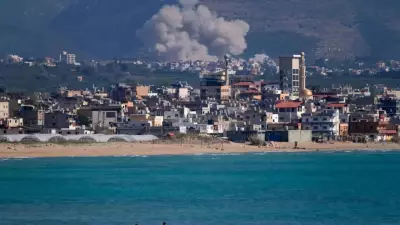
France is hosting the G7 summit amid the protracted West Asia conflict. The summit aims to address the conflict's economic consequences, such as the global energy crisis and its impact on the Global South, particularly partners like India.
Summit's Significance
The Évian summit comes at a pivotal moment, as consequences of the conflict weigh heavily on the global economy. In a sense, it brings the G7 back to the basics, as it was created in 1975 on France’s initiative to deal with the crisis following the first oil shock. True to this spirit, the French G7 Presidency aims to deliver tangible solutions. France has already contributed to G7 efforts to release strategic supplies in a coordinated manner to reduce impacts on global oil prices, including by coordinating with Gulf economies.
Strait of Hormuz and India's Role
President Macron is seeking an early US-Iran ceasefire agreement and immediate reopening of the Strait of Hormuz. He has remained in touch with Prime Minister Modi on the issue. France cannot accept the strait to be managed in a manner inconsistent with the UN Convention on the Law of the Sea and navigation rules. This precedent would have disastrous consequences in other parts of the world, particularly in the Indo-Pacific. France is fully committed to supporting the resumption of safe and unimpeded navigation through the Strait of Hormuz. Since the Paris Summit on Freedom of Navigation of April 17, which India attended, a broad international consensus has emerged in favour of freedom of navigation and the launch of a strictly defensive mission, distinct from other operations, once security conditions so allow. India’s participation would be a powerful signal.

India and Global Economic Imbalances
As global imbalances worsen, the involvement of India and other partner countries within the G7 has become indispensable. For the first time, India and other partner countries have been closely associated upstream of the summit, participating in Sherpa meetings and ministerial sessions. France is seeking to build collective momentum so that it can, together with the US and China, hold a serious discussion on the root causes of these imbalances. The second priority concerns the overhaul of international partnerships, for which working closely with India is crucial. France believes in moving away from the official aid approach towards genuine co-investment. Given India’s economic and demographic weight, its contribution to the discussion is of paramount importance.
Global Governance Reform
The G7 foreign ministers’ meeting this year stressed the need for global governance reform. The precise agenda of the summit is still being finalised. France’s position on this subject is well known. Reforming the Security Council, particularly by including India, Brazil, Germany, Japan, and two African states as permanent members, is key to strengthening its representativeness and legitimacy. France is convinced that such a reform is possible. It is, therefore, imperative to begin negotiations based on a draft text, without waiting for prior consensus, which has proved unattainable to date.
Critical Minerals and China
With the G7 also focused on critical minerals, the summit is expected to work on developing alternatives against China’s dominance. There is a clear momentum to reduce the exposure of value chains, minimise excessive dependencies, and combat non-market practices that distort fair competition. Concrete deliberations have already been undertaken under the French G7 presidency to converge on a framework to diversify supply sources. France hopes that these efforts will conclude successfully and be endorsed by as many states as possible. France is also organising a high-level event on critical mineral cooperation a few days ahead of the summit.

Defence Cooperation with India
Given the level of trust between India and France, defence cooperation remains a central pillar of the relationship. India recently issued a Letter of Request for 114 Rafale aircraft under the MRFA programme. With India expecting 94 of these to be built locally, questions arise about the percentage of technology transfer France will agree to, particularly regarding Safran M88 engine technology. As these discussions are ongoing, details cannot be disclosed. However, France intends this new acquisition to be in line with 'Make-in-India' requirements, similar to many other defence programmes developed with India.