

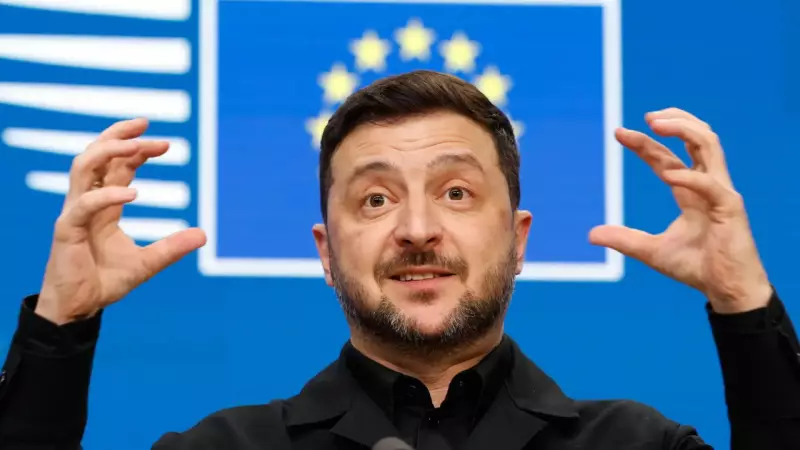
In a significant move aimed at restarting stalled diplomacy, Ukrainian President Volodymyr Zelensky has put forward a new proposal involving a potential demilitarized zone in the contested Donetsk region. The offer, made during a briefing with reporters in Kyiv on Tuesday, signals a notable shift in Ukraine's negotiating stance on one of the war's most contentious territorial issues.
A Conditional Withdrawal and a 20-Point Blueprint
President Zelensky stated that Ukraine is prepared to withdraw its military forces from the parts of the eastern Donetsk region it still controls. This area would then be transformed into a demilitarized zone. However, this major concession comes with a critical condition: Russia must pull its own troops back from an equivalent stretch of territory within Donetsk.
This proposal is a central component of a revised 20-point peace plan developed jointly by Ukrainian and American officials over recent weeks. Zelensky presented this comprehensive blueprint to the media, framing it as Ukraine's most sincere effort to find a diplomatic end to the conflict. The plan addresses a wide spectrum of issues, from future security guarantees for Ukraine to ambitious plans for national reconstruction.

Sticking Points: Donetsk and the Nuclear Plant
Despite the collaborative effort with Washington, President Zelensky acknowledged that two major sticking points remain unresolved between Ukraine and the United States. The first is the ultimate fate of the Ukrainian-held territory in Donetsk, which the new DMZ proposal seeks to address.
The second unresolved issue concerns the Zaporizhzhia Nuclear Power Plant, Europe's largest, which is currently under Russian occupation. Ukraine's compromise on this front involves a proposal for joint management of the plant with the United States, rather than demanding an immediate full return to Ukrainian control.
Kremlin's Response and Zelensky's Cautious Hope
The Ukrainian leader has now placed the ball firmly in Russia's court, stating that the response to this plan is up to Moscow. Initial reactions from the Kremlin, however, suggest a rocky path ahead. Russian officials have consistently demanded full military control over the entire Donetsk region and have dismissed notions of returning the Zaporizhzhia plant.
On Wednesday, Kremlin spokesperson Dmitry Peskov confirmed that President Vladimir Putin had been briefed on the negotiations. Peskov stated, "We aim to formulate our future stance and resume our contacts shortly." Despite the historical deadlock, Zelensky expressed a thread of cautious optimism. He suggested that Moscow might hesitate to openly reject this new proposal, potentially due to concerns about angering US President Donald Trump, who has recently re-engaged with mediation efforts.
The revised peace plan, born from weeks of US-mediated talks, represents the closest the sides have come to addressing the Donetsk dispute. Yet, the fundamentally opposing conditions for a demilitarized zone underscore the significant gaps that still exist between Kyiv and Moscow, leaving the prospect for a near-term breakthrough uncertain.






