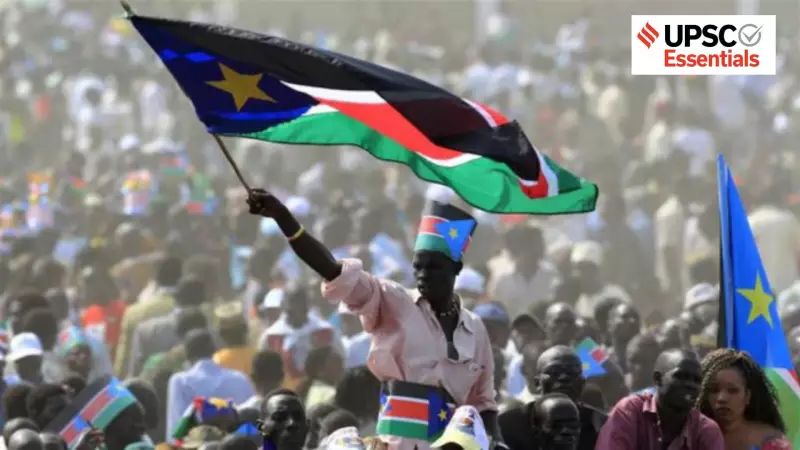
For nearly three years, Sudan, Africa's third-largest nation, has been ravaged by a brutal internal conflict. The war between the Sudanese Armed Forces (SAF) and the paramilitary Rapid Support Forces (RSF) has resulted in a catastrophic human toll: over 40,000 people killed, more than 14 million displaced, and parts of the country pushed into famine. Despite the scale of the humanitarian disaster, regional and international mediation efforts have repeatedly failed to stop the fighting.
The Stark Imbalance in Global News Coverage
Perhaps more puzzling than the failed diplomacy is the war's conspicuous absence from global headlines. Data from analytics firm Chartbeat, cited by The Economist, reveals a staggering disparity. In 2024, media coverage of Sudan averaged a mere 600 stories per month. In stark contrast, the conflicts in Gaza and Ukraine each garnered approximately 100,000 stories monthly. This lopsided attention raises a critical question: why does a war of such magnitude remain largely invisible to the world?
The answers lie in understanding long-standing theories of global media dynamics: the concepts of 'flow' and 'contra-flow.' These frameworks help explain how information moves—or doesn't move—from the Global South to the rest of the world.

The Historical 'Flow': Western Media Dominance
Following World War II, the 'free flow of information' became a cornerstone of American foreign policy, deeply intertwined with the ideological battles of the Cold War against the Soviet Union. This established a largely one-way vertical flow of news, from media powerhouses in the Global North to audiences in the developing Global South.
By the 1960s and 70s, this model faced intense criticism. Critics argued it was a form of cultural imperialism, exporting Western lifestyles while presenting an exploitative and distorted image of developing nations. This debate fueled calls for a New World Information and Communication Order (NWICO), championed by the Non-Aligned Movement alongside demands for a New International Economic Order (NIEO). UNESCO's MacBride Commission, established in 1977, made 82 recommendations aimed at democratizing global communication.
The Rise of 'Contra-Flow' and Its Limits
The 1990s and 2000s saw the economic rise of nations like India and China, paving the way for 'contra-flow'—information flowing back from the Global South to regional and global audiences. Scholars Oliver Boyd-Barrett and Daya Kishan Thussu coined the term to describe this phenomenon, particularly in news gathering.
This shift was enabled by the explosive growth of media outlets worldwide. Success stories like India's Bollywood and Qatar's Al Jazeera disrupted Western media monopolies. Al Jazeera's coverage of the 2003 Iraq War, for instance, was widely studied as a pivotal challenge to the US-led narrative.
Yet, in today's era of hyperconnectivity and social media—which promises grassroots contra-flow—the silence on Sudan persists. The country's complex history, marked by over a dozen military coups since 1956, multiple civil wars, and the Darfur genocide, seems to have led to 'compassion fatigue' or a perception of intractable conflict. The lack of strategic economic interests for Western powers, compared to Ukraine or the Middle East, further diminishes news value in traditional 'flow' models. Meanwhile, potent contra-flow voices from within Sudan or its region struggle to break into the mainstream global news cycle.
The case of Sudan underscores that while the architecture of global media has evolved, deep imbalances remain. The concepts of flow and contra-flow are not just academic; they are vital lenses through which to understand why some human tragedies command the world's attention while others unfold in the shadows.