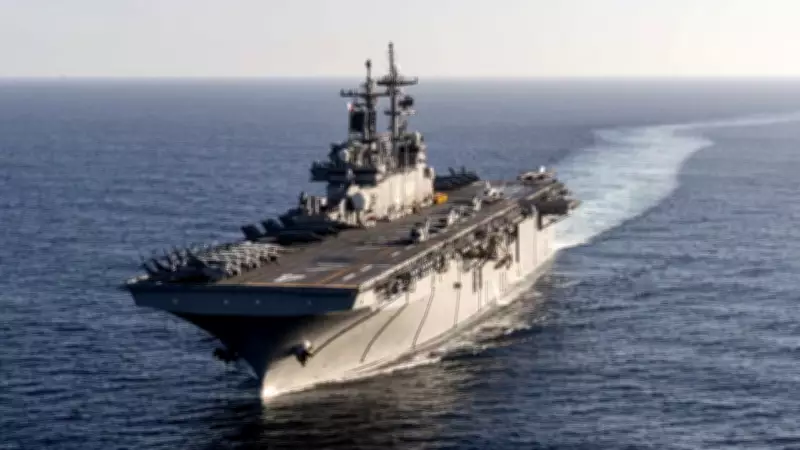
USS Boxer Enters the Equation: US 'Small Carrier' Warship Brings Jets, Marines, and Assault Power to Middle East
As tensions escalate in the Middle East, the United States is deploying a powerful naval group led by the USS Boxer, a Wasp-class amphibious assault ship designed to act as a mobile military base for Marines. This strategic move underscores Washington's commitment to strengthening its military posture in a region embroiled in conflict.
A Multi-Role Warship with Significant Air Power
Often compared to a small aircraft carrier, the USS Boxer can bring substantial air power to the region. It is capable of operating advanced F-35B stealth fighter jets, attack helicopters, and MV-22 Osprey aircraft, enabling it to conduct airstrikes and rapid-response missions with precision and agility.
However, its role extends far beyond aviation. The USS Boxer is specifically built to support amphibious assaults, allowing US Marines to launch operations directly onto hostile shores. This dual capability makes it a versatile asset in any large-scale military engagement.

Deployment Details and Troop Strength
The USS Boxer is deployed as part of a three-ship Amphibious Ready Group (ARG), which includes the USS Portland and USS Comstock. Together, these vessels are carrying thousands of Marines from the 11th Marine Expeditionary Unit (MEU). In total, the group comprises approximately 4,000 service members, including both Marines and sailors.
These forces recently completed extensive training exercises off the coast of California before departing from San Diego earlier this week. Officials noted that the deployment was accelerated, with troops cutting short their leave after certification to move swiftly toward the conflict zone.
The Boxer group is expected to take around three weeks to reach the Middle East, sailing through the Indo-Pacific region. Upon arrival, it will join other US naval assets already deployed, including another amphibious assault ship, the USS Tripoli.
Expanding Naval Power and Strategic Implications
This deployment comes as the conflict involving the US, Israel, and Iran nears its fourth week, with Washington steadily increasing its military presence. In recent weeks, the US has already deployed carrier strike groups and additional amphibious forces to bolster its position.
The amphibious group is equipped with a range of weapons, including missile systems such as Rolling Airframe Missiles and Sea Sparrow, alongside fighter jets, helicopters, and amphibious vehicles. According to reports, up to six amphibious ships could be operating in the region, carrying nearly 8,000 personnel, including thousands of Marines trained for rapid deployment.
The buildup has sparked growing speculation over potential US operations targeting strategic locations, including Iranian-held islands linked to oil infrastructure. The USS Boxer's ability to launch airstrikes while simultaneously deploying ground forces makes it a key asset in such scenarios.
Why the USS Boxer Matters
The USS Boxer stands out as a multi-role warship that combines the functions of an aircraft carrier, troop transport, and assault platform in a single vessel. Its capacity to carry more than 2,000 troops, along with combat equipment, landing craft, and command systems, enables it to sustain independent military operations effectively.
This deployment highlights the US military's focus on flexibility and rapid response in volatile regions. As global tensions persist, the USS Boxer's presence in the Middle East serves as a clear demonstration of American naval power and strategic readiness.