

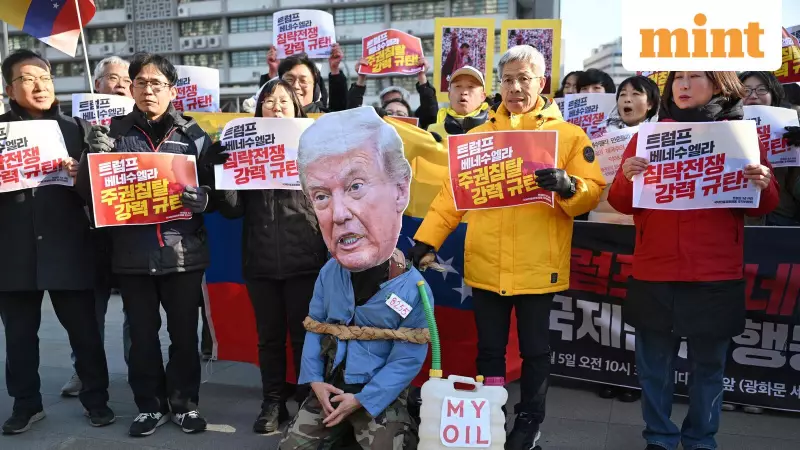
In a dramatic escalation of military intervention, United States forces conducted a major operation in Venezuela over the weekend, leading to the capture of the country's President, Nicolas Maduro, and his wife, Cilia Flores. President Donald Trump announced the 'large-scale strike' on Saturday morning, confirming that the couple has been indicted in New York on terrorism and narcotics charges. Trump accused Maduro of leading a 'narco terrorist organisation'.
Global Military Campaign in Trump's Second Term
This action in Venezuela marks the latest in a series of military engagements undertaken by the US during President Trump's second term, which began in January 2025. Despite Trump's inaugural pledge to 'restore peace' and end global conflicts, his administration has launched attacks in at least seven countries. Data from the nonpartisan Armed Conflict Location & Event Data project indicates that since 20 January 2025, the US has carried out or been a partner in 622 overseas bombings using drones or aircraft.
Speaking aboard Air Force One, President Trump stated that the US is now "in charge" of Venezuela following Maduro's capture. He noted that while he has not spoken directly with Venezuela's acting leader, Vice President Delcy Rodriguez, she is cooperating with American authorities.

From Nigeria to Iran: A Trail of Strikes
The scope of US military action has been global. On Christmas Day, the US launched what Trump termed 'powerful and deadly' strikes in Northwest Nigeria's Sokoto State against groups allegedly linked to ISIS. This was the first known kinetic US military action in the West African nation, conducted with Nigeria's agreement. Republican figures, including Ted Cruz, have accused Nigeria of enabling a 'Christian genocide,' a claim the government in Abuja denies.
In Somalia, the US has been particularly active, conducting at least 111 air strikes in 2025 at the Somali government's request. These attacks target groups like al-Shabab and ISIS-Somalia. However, reports from sites like Drop Site News indicate civilian casualties, including an incident in Lower Juba that killed at least 11 civilians, 7 of them children.
One of the most significant conflicts occurred on June 22, 2025, when US forces struck three key nuclear sites in Iran—Natanz, Isfahan, and Fordow—amid the Iran-Israel war. The Pentagon estimated the attack set back Iran's nuclear program by two years. In retaliation, Iran struck a US airbase in Qatar, though no casualties were reported. Trump later brokered a ceasefire, ending the 12-day war.
Contrasting Narratives: Peace Pledge vs. Military Reality
President Trump has frequently portrayed himself as a 'president of peace,' even claiming in 2025 to have ended eight wars worldwide and suggesting he deserved a Nobel Peace Prize. However, the reality of sustained military campaigns from Venezuela to Yemen, Syria, and Iraq paints a different picture. The administration's actions have resulted in significant geopolitical volatility and raised concerns over civilian deaths.
The capture of Nicolas Maduro represents a bold and controversial move, potentially reshaping political dynamics in Latin America. Meanwhile, Trump's warning to Iran—"Now I hear that Iran is trying to build up again, and if they are, we’re going to have to knock them down"—signals that further military confrontation remains a distinct possibility.
The key takeaways are stark: the Trump administration's second-term strategy has involved military force across multiple continents, claims of peacemaking stand in sharp contrast to ongoing conflicts and civilian tolls, and US interventions are actively altering the geopolitical landscape in regions like West Africa and South America.






