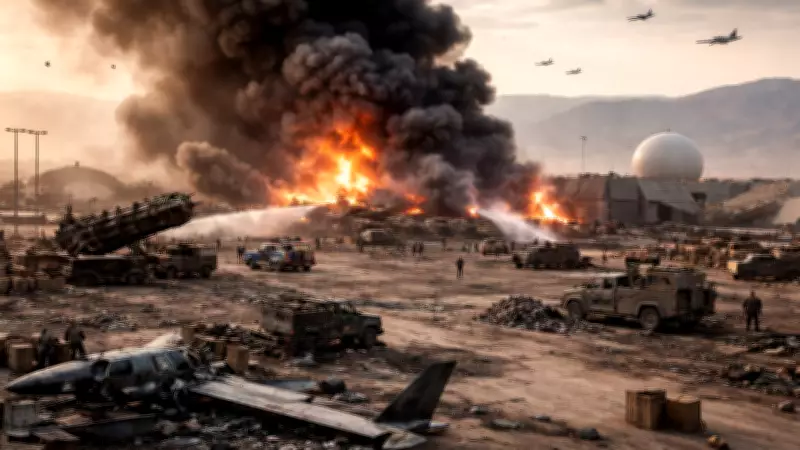
$800 Million Blow: US Military Infrastructure in Middle East Heavily Damaged by Iran Strikes
The escalating Middle East war has now entered its third week, with no signs of de-escalation from the United States, Israel, or Iran. According to a report by the Center for Strategic and International Studies (CSIS), Iranian strikes on US military bases in the region have inflicted an estimated $800 million in damage within just the first two weeks of the conflict.
Underreported Damage and Initial Retaliatory Strikes
Much of this extensive damage occurred during Iran's initial retaliatory strikes, which were launched in response to opening attacks by the US and Israel. Mark Cancian, a senior adviser at CSIS and co-author of the think tank study, emphasized that the damage to US bases has been underreported. "Although that appears to be extensive, the full amount won't be known until more information is available," he stated, highlighting the ongoing assessment challenges.
Targeted Strikes on Critical US Infrastructure
Iran's retaliatory operations have focused on degrading US air-defense and satellite-communication systems across strategic locations, including Jordan, the United Arab Emirates, and other key sites in the Middle East. A significant component of the damage was inflicted on the AN/TPY-2 radar system at an air base in Jordan. This radar, part of the Thaad missile defense system, is valued at approximately $485 million and is critical for intercepting long-range ballistic missiles, according to BBC reports.

Additional Iranian strikes caused an estimated $310 million in damage to buildings, facilities, and other infrastructure on US bases. Satellite imagery reveals that at least three US air bases—Ali Al-Salim in Kuwait, Al-Udeid in Qatar, and Prince Sultan in Saudi Arabia—were hit multiple times.
Human and Material Losses
Beyond equipment and infrastructure losses, the US has suffered significant human casualties. Since President Donald Trump joined Israel in launching attacks on Iran on February 28, 13 US service members have been lost. According to the US-based Human Rights Activists News Agency (Hrana), the overall death toll in the conflict is estimated at nearly 3,200, including around 1,400 civilians.
President Trump has maintained a confident stance, stating during a White House event, "We're doing extremely well in Iran." However, the material losses tell a different story.
Aircraft and Radar Systems Targeted
Iran has managed to target and damage several high-value aircraft despite the technological superiority of the US and Israeli air forces. In total, the US has suffered damage to 16 aircraft in the conflict, including 12 MQ-9 Reaper drones, each costing up to $56.5 million.
Notable incidents include the loss of three F-15 Strike Eagle fighter jets in Kuwait on March 2, reportedly due to a friendly fire incident, and a KC-135 refueling tanker lost over Iraq on March 12, killing all six crew members aboard. Another KC-135 was damaged in the same incident. In a significant development, Iran reportedly struck a US F-35 stealth fighter on March 19, with the US Central Command confirming an emergency landing and stable pilot condition.
Meanwhile, Israel has reportedly lost over a dozen drones in Iranian airspace, bringing the combined aircraft losses for both countries to 28.
Degradation of Missile Defense Networks
Iran's strikes have also focused on degrading the US missile defense network in the region. Up to four AN/TPY-2 radars associated with Thaad systems have reportedly been hit, including sites in Jordan, the UAE, and Saudi Arabia. Each radar is valued between $300 million and $500 million, with damage rendering some inoperable.
An AN/FPS-132 Block 5 Upgraded Early Warning Radar at Al Udeid Air Base in Qatar, valued at $1.1 billion, was also struck. This radar provides long-range ballistic missile detection and supports integrated defense systems such as Thaad, Patriot, and Aegis.
The Islamic Revolutionary Guard Corps (IRGC) declared, "The missile hand of the Islamic Republic of Iran has been opened for successful target hits," underscoring their operational success.

USS Gerald R Ford Fire Incident
In a related development, the US Navy's most advanced aircraft carrier, USS Gerald R Ford, was rendered temporarily inoperable due to a fire on March 12. Crew members spent over 30 hours controlling the blaze, which affected the ship's main laundry spaces. The incident is under investigation, with possibilities including deliberate sabotage or crew fatigue, as the carrier had been deployed for nearly ten months, far exceeding normal operational timelines. The ship is scheduled for repairs at Naval Support Activity Souda Bay in Crete.
Rising Financial Strain of the Conflict
The conflict has placed an immense financial strain on the US. According to CSIS, munitions costs alone exceeded $12 billion in the first six days, roughly $2 billion per day. The Pentagon estimates the first six days cost $11.3 billion, with the first 12 days reaching $16.5 billion.
Weapons costs are significant, with each Tomahawk missile costing around $3.5 million and over 300 used, totaling more than $1.2 billion. To sustain the war effort, the Pentagon has requested an additional $200 billion in funding from Congress. Defense Secretary Pete Hegseth emphasized the need, stating, "It takes money to kill bad guys."
Vulnerabilities and Operational Risks Exposed
The ongoing conflict has exposed vulnerabilities in some of the US military's most advanced systems. Iran's cost-effective strikes have challenged the perception of invulnerability in modern warfare, illustrating operational and reputational risks.
While the US and Israel have inflicted damage on Iran's military, the losses and degradation of advanced equipment highlight the mounting costs of managing operations and finances as the war continues.