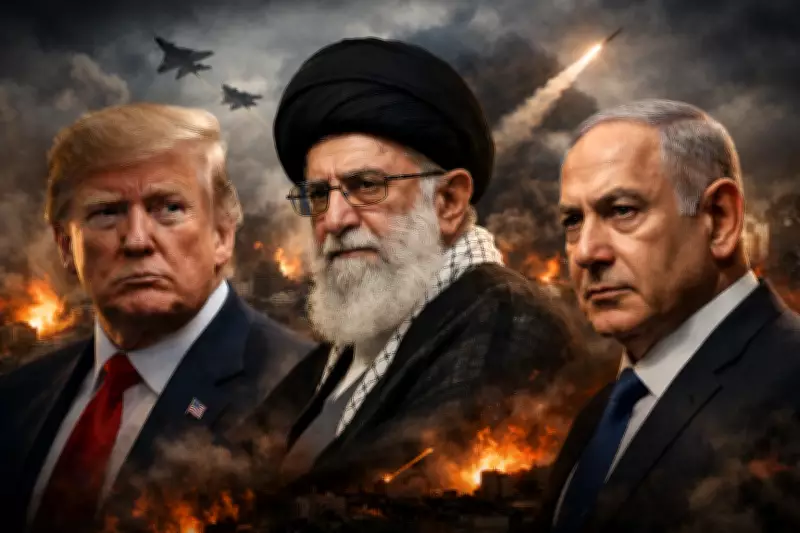
US-Israel Strikes Escalate Middle East Conflict, Iran Retaliates with Missiles
A fresh wave of coordinated strikes by the United States and Israel on Iranian targets has dramatically escalated an already volatile confrontation in the Middle East, pushing Tehran and Tel Aviv deeper into open conflict. This development follows days of sustained Israeli operations that have reportedly killed over 240 people in Iran, including senior military figures. In retaliation, Iran has unleashed repeated missile barrages on major Israeli cities such as Tel Aviv and Haifa, signaling that the standoff has moved beyond shadow warfare and proxy exchanges into a direct and dangerous phase.
Escalation and Damage Assessment
The full extent of the damage on either side remains unclear, with precise details of the sites hit and the scale of destruction difficult to independently verify amid an ongoing information war. Missiles have struck locations including a US navy headquarters in Bahrain, with explosions reported in Abu Dhabi and Doha. As both sides trade fire and threats widen, the critical question now is not just how much damage has been inflicted, but how long this confrontation can be sustained and how far it could spread across the region.
It is equally uncertain how long both countries can maintain the current tempo of attacks, given the lack of clarity over missile stockpiles and munitions reserves. However, what is clearer is Iran’s missile depth. Tehran is widely assessed to possess the largest ballistic missile programme in the Middle East, with thousands of missiles of varying ranges and speeds. At the current rate, Iran could sustain strikes for weeks, presenting a significant threat to Israel, which has largely faced attacks from non-state actors in Gaza, Lebanon, and Yemen.

Advanced Systems and Air Defence Challenges
Iran has also begun showcasing its more advanced missile systems. The Haj Qassem missile, reportedly used against Israel for the first time recently, is said to have evaded Israeli air defences. Visual evidence from impact sites suggests greater speed and destructive capability compared to older missiles deployed in earlier waves. While Tehran does not have unlimited numbers of such advanced systems and is likely to ration them, when combined with conventional ballistic missiles and large numbers of drones, they provide Iran with enough capacity to sustain short-term pressure and challenge assumptions about its staying power.
Israel’s air defence network, including the Iron Dome, is being pushed to its limits by the volume and intensity of incoming fire. Israel has leaned on the United States for additional interception support, reinforcing the strategic depth of the alliance. Washington, under President Donald Trump, has insisted it is not formally a party to the conflict, while warning of severe consequences if Iran targets US interests. American military bases across the Middle East remain within reach of Iranian missiles, making them potential flashpoints if escalation spirals.
Strategic Levers and Economic Implications
For Tehran, directly striking US assets would be a high-risk move. Supreme Leader Ayatollah Ali Khamenei has historically calibrated responses to avoid triggering full-scale American intervention. A direct confrontation could invite a joint Israeli-US offensive capable of degrading Iran’s most fortified nuclear and military facilities. Such a scenario could also draw in countries hosting US bases, including Kuwait, Qatar, Saudi Arabia, and Turkiye. Tehran is unlikely to want to widen the conflict in ways that alienate regional actors that could otherwise serve as mediators.
Beyond direct military exchanges, Iran retains asymmetric tools. Chief among them is the Strait of Hormuz, the narrow maritime corridor between Iran and Oman through which millions of barrels of oil transit daily. Oil markets have already reacted nervously, with prices briefly touching $78 per barrel before easing. Analysts suggest that any disruption in Hormuz could push prices above $100, triggering global economic ripple effects. Closing or threatening to close the strait remains one of Tehran’s strongest strategic levers, yet it carries risks, as retaliation would be swift and Iran’s own economic interests could suffer.

Searching for a Diplomatic Exit
While Iran has the capacity to sustain missile attacks in the near term, long-term constraints loom. A protracted war risks economic strain, infrastructure damage, and potential domestic unrest. Israel, with US backing, may find it easier to replenish munitions and maintain operational continuity. Tehran has signalled conditional openness to de-escalation, with Iran’s Foreign Minister Abbas Araghchi stating that once Israeli attacks stop, Iran will reciprocate. Iran has also indicated readiness to resume nuclear negotiations with Washington.
Whether that path materialises depends heavily on the United States. President Trump’s messaging has oscillated between calls for restraint and stern warnings to Tehran. Reports that Washington maintained diplomatic overtures while aware of Israeli military planning have deepened Iranian mistrust. Even so, an American-brokered arrangement may be the most realistic route to halting the confrontation, providing Israel with security assurances while offering Tehran a diplomatic exit from an increasingly costly standoff.
For now, Iran appears to be walking a narrow line, attempting to project deterrence and demonstrate military capability while avoiding actions that would trigger direct US entry into the war. How long this calibrated strategy can hold, as casualties mount and damage accumulates, remains an open question, with the world watching closely as the conflict unfolds.