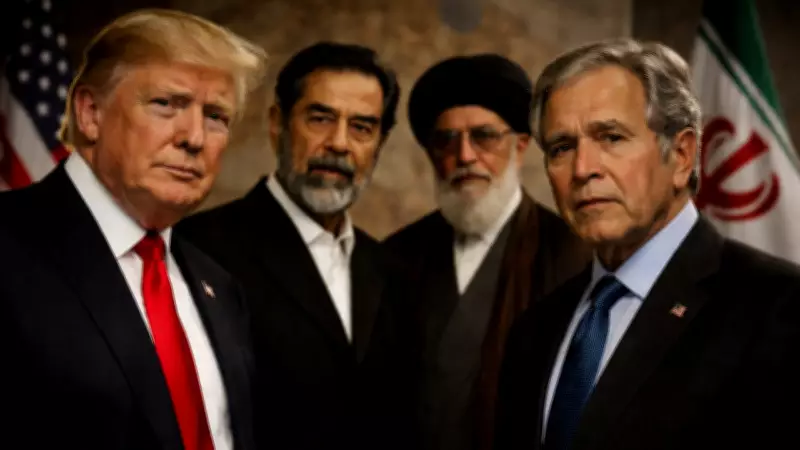
From Freedom to Fury: 23 Years On, US Trapped in Costly Middle East War Loop
Twenty-three years ago, the United States launched a dramatic invasion of Iraq with an air of certainty and spectacle. The initial strikes were marketed as decisive and clinical, showcasing overwhelming force aimed at neutralizing threats and reshaping the Middle East. Instead, the conflict spiraled into a prolonged and grinding unraveling, marked by immense human and financial costs.
The Heavy Toll of the Iraq War
The Iraq war proved enormously costly on multiple fronts. American military losses included approximately 4,500 killed and 32,000 wounded, while British forces suffered around 179 fatalities and numerous coalition injuries. Civilian deaths in Iraq reached hundreds of thousands, and the financial burden soared into trillions of dollars when accounting for full stabilization expenses. The "shock and awe" campaign that swiftly toppled Saddam Hussein gave way to a protracted insurgency and occupation, widely criticized as a strategic blunder in hindsight.
Current Conflict: US-Israel War on Iran Inflicts Heavy Losses
Today, the new US-Israel war on Iran is already inflicting severe casualties and destruction. Intense air strikes have left Tehran shrouded in smoke, with Iran's health ministry reporting at least 1,444 killed and 18,500 injured, though other monitors suggest over 3,000 fatalities. Tens of thousands have fled across Iran, and proxy forces like Hezbollah and Iraqi Shi'ite militias have seen hundreds killed, while Israeli strikes in Lebanon have claimed nearly 1,000 lives.

US losses, though comparatively lighter, remain politically sensitive, with 13 service members killed by Iranian attacks and accidents, and around 200 wounded. Financially, costs are mounting rapidly, with early estimates indicating $3.7 billion spent in the first four days and $16.5 billion by day twelve of the campaign. This escalating death and destruction eerily mirror the early stages of the 2003 Iraq invasion.
Justifications for Invasions: Iraq 2003 vs. Iran 2026
Iraq 2003: Then-President George W. Bush justified the invasion on security grounds post-9/11, claiming Saddam Hussein possessed weapons of mass destruction (WMD) and had ties to al-Qaeda, posing an imminent threat. Despite later findings that WMD allegations were unfounded and Saddam's nuclear programs had largely shut down, Bush argued that defiance and past aggression warranted force, leading to regime change and years of chaos.
Iran 2026: President Donald Trump's administration cites Iran's alleged nuclear ambitions, advanced missile programs, and support for groups like Hamas as justifications for strikes. Trump frames the war as targeting Iran's arsenal and punishing proxies, with rhetoric hinting at regime change, though advisers deny this goal. Unlike 2003, this action lacks broad international consensus, with Trump presenting his case through limited channels.
Parallels Between Iraq and Iran Invasions
Both conflicts share striking similarities as pre-emptive strikes against Middle Eastern foes accused of WMD or nuclear threats. In 2003, Bush insisted Saddam could not pursue WMD, while in 2026, Trump argues Iran must never obtain a bomb. Both administrations presented alarming intelligence assessments later disputed by skeptics, and both framed invasions in dramatic terms with early success declarations.
Political patterns also echo, with bipartisan support in 2003 contrasting uniform Democratic opposition in 2026. The broad outlines of preventive attacks, contested intelligence, and dubious claims create a familiar narrative of history repeating itself.
Iran's Lessons from the Iraq Invasion
Iran learned critical lessons from the Iraq war, shaping its current strategy. Observing Iraq's centralized system collapse, Iran adopted a decentralized "Mosaic Defence," allowing operations to continue despite leadership strikes. It also embraced asymmetric warfare, using drones, missiles, and cyber tools to exploit vulnerabilities rather than engage in direct confrontation.

Iran noted that the US withdrew from Iraq due to high costs and unpopularity, not battlefield defeat, leading to a strategy focused on making conflicts long and costly. Additionally, Iran invested in proxy forces across the region, projecting influence while avoiding direct clashes.
Key Differences: Offensive Strategy and Allies
Despite parallels, significant differences exist. The 2003 invasion involved ground forces and occupation, whereas the 2026 conflict is limited to air power, reducing quagmire risks but complicating verification of objectives like nuclear program destruction.
Allied cooperation diverges sharply: Bush assembled a "coalition of the willing" with dozens of countries, while Trump's war has almost no foreign military partners beyond Israel, with European nations like Germany and the UK refusing participation and criticizing the lack of UN mandate.
What's Next: Uncertain Future and Lingering Echoes
If Iraq taught Washington anything, it's that wars are defined by their lingering aftermath, not just their beginnings. The Iran conflict now sits at a similar uncertain threshold, with risks of escalation due to contested intelligence, limited international backing, and unclear endgames. Iran's resilience and regional volatility suggest that resolution may remain elusive, with patterns of history setting a cautionary tale for future engagements.