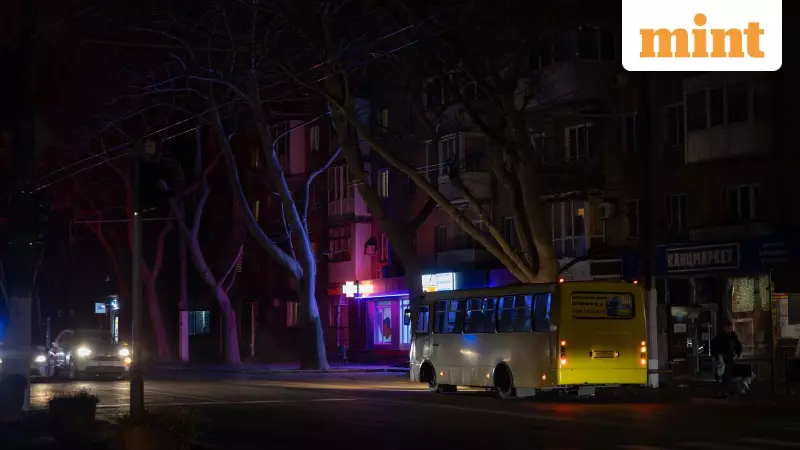
As the festive season of Christmas approaches, Ukraine is plunged into its most severe energy crisis since the full-scale invasion began in 2022. The nation's power grid is at a critical tipping point following an unprecedented wave of Russian missile and drone attacks targeting energy infrastructure, leaving millions in prolonged darkness and cold.
Unprecedented Scale of Attacks Cripples Power Generation
The situation has deteriorated sharply compared to previous winters. While Ukrainians had grown accustomed to scheduled blackouts lasting hours, the current reality is far more dire. In November alone, Russian forces launched more than 5,000 missiles and long-range drones into Ukraine, with a significant proportion aimed at the energy sector. This marks a dramatic escalation; where a major attack last winter might involve 100 projectiles, now assaults can include up to 500.
The technology used has also evolved. The long-range Shahed-style drones now fly faster and at higher altitudes, making them far more difficult for Ukrainian air-defense systems to intercept. The cumulative damage over four years of war is staggering. Russia has seized control of a nuclear power plant and several coal plants, while numerous hydroelectric and thermal facilities have been damaged or destroyed, according to Ukraine's Ministry of Energy.

President Volodymyr Zelensky stated earlier this month that there isn't a single power plant in the country left undamaged by Russian attacks. Maxim Timchenko, CEO of DTEK, Ukraine's largest private energy company, painted a grim picture: "Ukrainians face an unprecedented energy crisis. Imagine what a power station looks like after being hit by five ballistic missiles, and that’s in just one Russian attack. I fear this will be the hardest winter since the invasion."
Life in the Dark: Hardship and Resilience on the Ground
The human cost of this infrastructure crisis is immense. For four consecutive days this month, Oleksandra Mazur, a 23-year-old resident of Odesa, had no light, heat, or running water after strikes cut power completely to her neighborhood. "It’s much worse than last year," she said. "We’re not in any mood to celebrate. We don’t know what Christmas and New Year will look like—whether we’ll be able to cook a meal."
In the capital, Kyiv, blackouts now routinely exceed 12 hours a day in some districts. Near the front lines, 12 hours of electricity is considered a luxury. However, the port city of Odesa has been hit exceptionally hard this winter. The region produces very little of its own energy, relying on imports, making it particularly vulnerable to targeted strikes aimed at severing its connection to the national grid.
Oleh Karin, a 45-year-old construction worker in Odesa, frequently hikes up nine flights of stairs to his apartment during outages, carrying water from a nearby pump. His 11-year-old son, Nazar, builds models of military equipment from Legos during the blackouts. "The children understand—they know exactly who is responsible," Karin said emotionally. Despite the hardship, he finds moments of connection: "When there’s no electricity, we spend more time together... We sit together, playing board games or cards. In its own way, it’s even romantic."
A New Russian Strategy and the Challenge of Recovery
Ukrainian officials report a shift in Russian tactics. Mykola Kolisnyk, a deputy energy minister, explained that in addition to targeting major substations on the national network, Russia has begun focusing on facilities owned by local energy companies in specific regions, especially near the front. "They can’t black out the whole country," Kolisnyk said. "So they’re trying to create instability in the local area." Single facilities have been hit by up to 50 drones and missiles in a single night.
Oleksandr Kharchenko, director of the Energy Industry Research Center in Kyiv, noted that Russia is now attacking not just well-protected voltage substations but also the roughly 3,500 distribution substations across Ukraine, which are nearly impossible to defend entirely. "When a big attack happens, in that region, the next four to five days will be very complicated," he stated.

Recovery is a monumental task. Energy companies have stockpiled spare parts, but supplies are limited and dwindling. Ukraine has lost nearly 2.5 gigawatts of coal-fired power plant capacity, damage that cannot be quickly restored. "It will be quite a few months. Not everything can be maintained," Kharchenko admitted.
For some, like Nataliia Bakhtar who moved to Odesa from Russian-occupied Mariupol, the blackouts are a lesser evil. Her husband was detained for three and a half years before a prisoner exchange. "Life under occupation was also very hard," she said. "Better to be together, in Ukraine, without electricity, than to live through what we went through before." As Ukraine braces for a Christmas in the dark, this sentiment of defiant resilience continues to flicker, even when the lights do not.