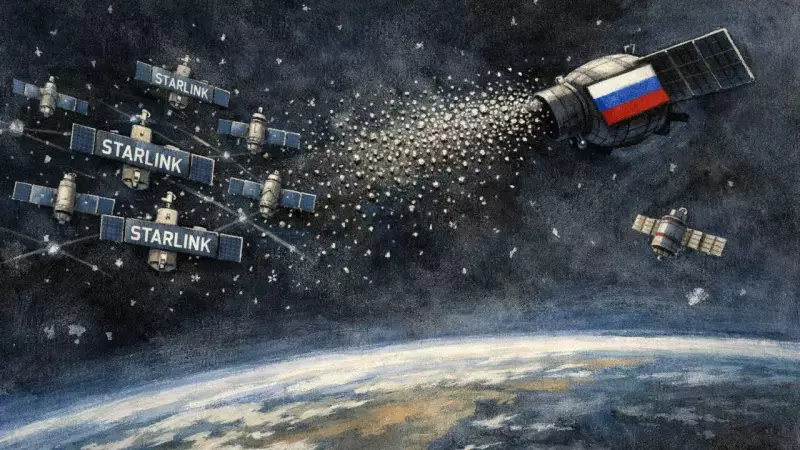
NATO intelligence agencies suspect Russia is working on a new and dangerous type of anti-satellite weapon specifically aimed at Elon Musk's Starlink satellite constellation, according to a report seen by the Associated Press. This development comes as Starlink has become a vital military and civilian communications lifeline for Ukraine in its war against Russia.
The 'Zone-Effect' Weapon: A New Kind of Space Threat
The suspected Russian system represents a significant shift from traditional anti-satellite technology. Instead of using a missile to destroy a single satellite, this new weapon is designed to release hundreds of thousands of tiny metal pellets into orbit. Intelligence findings describe it as a "zone-effect" weapon because it would affect a large area of space, potentially damaging or disabling multiple satellites simultaneously.
The intelligence, shared with AP on the condition of anonymity for the involved services, suggests the pellets would be extremely small and difficult to detect with current tracking systems. This could make attributing blame for satellite damage a slow and complex process. Experts cited in the report warn that even tiny impacts could cripple sensitive satellite components like solar panels, knocking them offline.

Why Starlink is in the Crosshairs
The potential target of this system is no accident. Since Russia's full-scale invasion began, Starlink has evolved into a key communications backbone for Ukraine. Ukrainian forces rely on it for battlefield coordination and targeting, while civilians and government officials use it when Russian strikes cripple terrestrial networks. Moscow views this commercial satellite network as a direct threat and has previously warned that satellites aiding Ukraine's military could be considered legitimate targets.
This stance exists alongside Russia's public diplomatic efforts. The country has supported United Nations initiatives to prevent weapons in space, and President Vladimir Putin has stated Moscow has no plans to deploy nuclear weapons in orbit.
High Risks and Expert Skepticism
The report has sparked debate among space security experts about the practicality and likelihood of such a weapon's deployment. Some, like Victoria Samson of the Secure World Foundation, express deep skepticism. "I don't buy it," she told AP, noting she would be surprised if Russia deployed a system that could render parts of space unusable, potentially harming its own and allied satellites, including China's.
However, others caution against dismissing the threat. Canada's military space division commander, Brigadier General Christopher Horner, said the idea cannot be ruled out, pointing to past U.S. allegations about Russia exploring nuclear space weapons. He suggested a less extreme but still damaging system was plausible.
The core danger of any anti-satellite test or weapon is the creation of long-lasting space debris. Debris travels at immense speeds, and even small pieces can cause catastrophic damage. Once created, this debris can remain in orbit for years, threatening all spacecraft, including those used for communication, navigation, and weather monitoring.
The intelligence does not specify when such a system might be operational or if it has been tested. An official familiar with the findings indicated the work is still under development and could be experimental. The U.S. Space Force did not comment on the report, while France's Space Command accused Russia of "multiplying irresponsible, dangerous, and even hostile actions in space" in recent years.
Ultimately, experts note that the mere threat of such a capability could be used as a geopolitical tool. However, the potential for blowback on Russia's own significant space assets remains a powerful deterrent. As Samson concluded, "They've invested a huge amount in being a space power. Doing this would hurt them, too."