

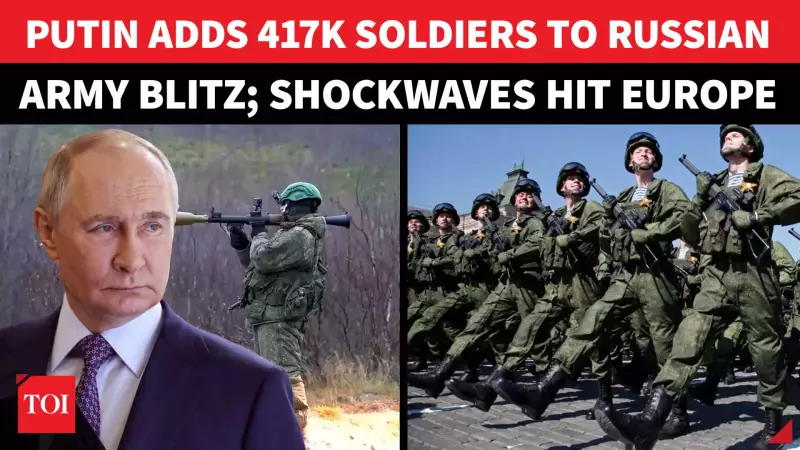
In a significant development that has sent shockwaves through Western defence circles, Russia has announced a major expansion of its military personnel. Official figures reveal a sharp increase in recruitment, raising serious concerns among European leaders about Moscow's long-term intentions beyond the ongoing conflict in Ukraine.
A Massive Influx of Military Personnel
According to senior Russian officials, the country's armed forces have been substantially bolstered through a dual-track recruitment process. More than 417,000 individuals have been signed up as contract soldiers in a concerted drive to professionalise and expand the military's core. Complementing this figure, over 36,000 volunteers have been deployed directly to active combat units. This combined addition of over 450,000 personnel represents one of the most substantial peacetime military buildups in recent European history.
The announcement, made in late December 2025, comes at a time of heightened geopolitical friction. The figures are not merely statistical but are seen as a potent indicator of Russia's military preparedness and strategic posture. The scale of this recruitment suggests a sustained effort to maintain and potentially increase operational capacity.

NATO's Growing Apprehension and Kremlin's Denials
This military surge has directly fueled anxieties within the North Atlantic Treaty Organization (NATO). European leaders have increasingly voiced warnings that Moscow might be preparing the groundwork for a broader confrontation that could extend beyond the borders of Ukraine. The fear is that the amassed manpower and resources could be leveraged for offensive operations against NATO member states in Eastern Europe, fundamentally altering the continent's security landscape.
The Kremlin, however, has strongly rebuffed these allegations. Russian President Vladimir Putin has personally dismissed claims that Russia harbours plans to attack any European nation. In a familiar rhetorical counter, Putin has accused NATO of deliberately exaggerating the threat posed by Russia to justify its own military expansion and continued support for Ukraine. This creates a familiar cycle of accusation and denial, where military preparations are viewed as defensive by one side and ominously offensive by the other.
Implications for Global Security and the Road Ahead
The implications of this troop surge are profound. For NATO, the numbers necessitate a recalibration of risk assessment and defence planning. The alliance is likely to face increased internal pressure to enhance its own readiness levels, reinforce its eastern flank, and ensure robust deterrence measures are in place. The development also casts a long shadow over any potential near-future negotiations to end the war in Ukraine, as it signals Russia's commitment to a prolonged conflict or a fortified long-term stance.
Furthermore, this move impacts global arms dynamics and diplomatic efforts. It underscores the deepening militarisation of the Russia-NATO divide and makes the de-escalation of tensions significantly more challenging. The international community, including major powers like India which maintain relationships with both sides, will be watching closely. The key questions now are how NATO will formally respond to this demonstrated capability and whether this marks a new, more dangerous phase of post-Cold War confrontation in Europe.
As the situation develops, the world is left to ponder whether this is a strategic bluff, a posture for negotiation, or a genuine preparation for an escalated conflict. The coming months will be critical in determining the answer.






