

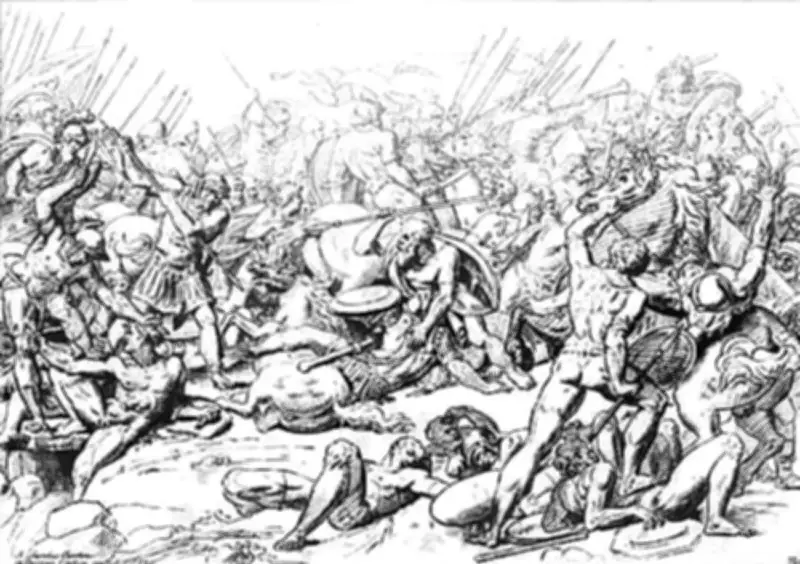
The Peloponnesian War: A Pivotal Struggle That Transformed Ancient Greece
The Peloponnesian War, spanning from 431 to 404 BCE, stands as one of the most defining and catastrophic conflicts in the history of the ancient Greek world. This protracted war pitted Athens and Sparta, along with their respective allies, in a brutal struggle that extended far beyond mere military engagements, fundamentally altering the political, economic, and social fabric of Greece.
The Core Conflict: Power, Pride, and Political Ideologies
At its heart, the Peloponnesian War was a clash between two vastly different forms of government and societal structures. Athens, a naval democracy with a powerful fleet, faced off against Sparta, an oligarchy renowned for its formidable land-based military. The ancient historian Thucydides, who participated in the war, famously observed, "It was the rise of Athens and the fear that this inspired in Sparta that made war inevitable." This quote underscores how fear, ambition for power, and intense competition drove the conflict, which raged for nearly three decades without a swift resolution, inflicting immense suffering across the Greek peninsula.
Economic Devastation and Social Collapse
One of the most severe impacts of the Peloponnesian War was the widespread economic destruction that crippled ancient Greece. The conflict severely disrupted daily life and economic activities, with farmlands, particularly in the region of Attica, being ravaged by Spartan invasions. This forced many residents to flee to the overcrowded city of Athens, exacerbating hardships. Additionally, a devastating plague, as described by Thucydides, struck during the war, leading to what he termed "lawlessness" and the breakdown of social structures. The plague claimed thousands of lives, including the influential leader Pericles, further destabilizing the economy and eroding the social cohesion of Greek city-states, leaving them resource-depleted and economically shattered.

Political Instability and the Erosion of Greek Unity
The war also precipitated profound political instability throughout the Greek world. The ideological clash between democracies and oligarchies fueled coups and internal strife in various city-states. Thucydides noted that during this period, "words had to change their ordinary meaning," highlighting the chaotic and volatile political environment. Instead of uniting against external threats, the Greek city-states engaged in incessant infighting, with alliances shifting and trust eroding. Even after Sparta emerged victorious in 404 BCE, peace remained elusive, as Sparta struggled to maintain order, leading to subsequent conflicts like the Corinthian War. This marked the definitive end of Greece's "Golden Age," leaving the region fragmented and vulnerable.
Long-Term Consequences: Paving the Way for Macedonian Domination
Perhaps the most enduring legacy of the Peloponnesian War was how it set the stage for external conquest. The divided and weakened Greek city-states were ill-prepared to resist the rising power of Macedon. In the mid-4th century BCE, Philip II of Macedon capitalized on these internal divisions to assert control over Greece, effectively ending the independence of the classical Greek city-states. The historian Xenophon, in his continuation of Thucydides' work, documented the prolonged instability and turmoil that followed the war, underscoring its devastating aftermath which persisted for decades.
A War That Altered the Course of History
In summary, the Peloponnesian War not only determined the victor between Athens and Sparta but also unleashed an unmitigated disaster upon ancient Greece. The economic ruin, social disintegration, and political chaos created a profoundly unstable environment, transforming a once-flourishing civilization into a weakened and disarrayed entity. From the detailed accounts of historians like Thucydides and Xenophon, we gain a clear understanding of how internal division can devastate even the most powerful nations, serving as a stark reminder that civilizational collapse often stems from within rather than from external adversaries.






