A Palestinian family in the northern West Bank has recounted how Israeli settlers compelled them to exhume the freshly buried remains of an elderly relative, alleging the grave was situated too near a settlement recently sanctioned by Israel's government.
Incident Details
Mohammed Asasa stated that his family had coordinated the burial of his 80-year-old father, Hussein, with the Israeli military. The burial took place in a cemetery belonging to their village, also named Asasa, where generations of family members have been interred in clearly marked graves, according to the family.
The event, which occurred last Friday, underscores the growing influence of extremist settlers during the past four years of Israel's current administration and the military's apparent inability or reluctance to curb settler violence and land appropriations.

Asasa recounted that after the funeral, armed men from the nearby settlement of Sa-Nur arrived and ordered the family to exhume the body, asserting that the land belonged to the settlement, located less than half a kilometer away.
"While we were receiving condolences at home, some young men from the village came running and told us that the settlers were digging at the grave we had just buried at the cemetery," he said. "When we reached the cemetery we found it filled with settlers and the army surrounded by them." He added that villagers decided to exhume the remains themselves after settlers threatened to use a bulldozer to dig up the grave. Video footage showed them carrying the body from the cemetery with military escorts, while men who appeared to be settlers stood further uphill.
"This had never happened before," Asasa remarked. "You have no other choice."
Military Response
The Israeli military stated that forces responded to reports of clashes at the site and confiscated settlers' digging tools. It claimed that the army did not force the family to move the remains but instead protected them as they relocated the body to a nearby cemetery. The military did not confirm any arrests.
Israel evacuated Sa-Nur in 2005, but settlers opposed to that withdrawal have spent years attempting to reestablish it as an outpost. Israel reauthorized the settlement in 2025 and reestablished it last month with a ceremonial ribbon-cutting attended by several government ministers. Prime Minister Benjamin Netanyahu's government is largely composed of settler leaders and their allies.
Palestinians and most of the international community consider all settlements in the occupied West Bank illegal and obstacles to peace, classifications that Israel disputes.
The administration of U.S. President Donald Trump has cultivated strong ties with settler representatives, a departure from his predecessors.
Asasa expressed confusion about future funerals. "Are we going to go around the neighboring villages asking for a place to bury them?" he questioned.
Separate Incident: Palestinian Man Shot Near School
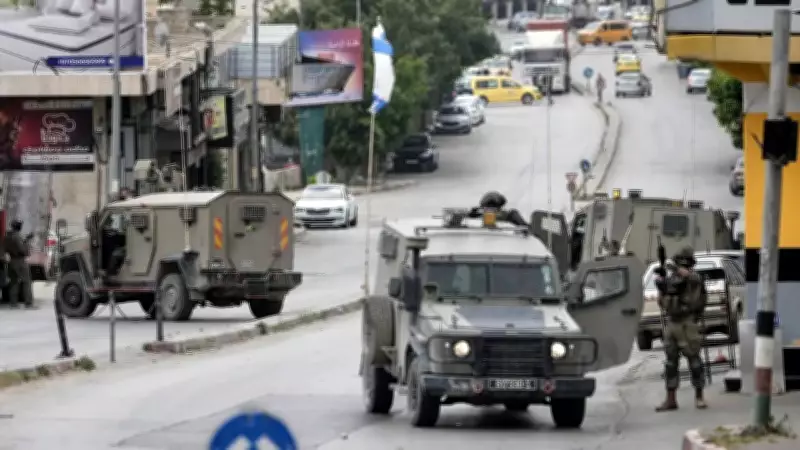
In a related development, a Palestinian man, whom Israeli police said was armed with a rifle, was shot and killed on Monday by Israeli forces near a school for refugees on the outskirts of Jerusalem.
Israeli police reported that the man was shot after exiting his car with a military-style rifle. The Ramallah-based Palestinian Health Ministry identified him as Ayman Al-Hashlamoun, a 30-year-old from Kufr Aqab on Jerusalem's northern outskirts. The ministry stated that his body remained in Israeli custody.
The shooting, which occurred outside a school run by the United Nations Relief and Works Agency in Kufr Aqab, near the Qalandia refugee camp, comes amid broader violence in the occupied West Bank as Israel authorizes new settlements and revises administrative measures governing areas under its control.
As of May 3, at least 45 Palestinians have been killed by Israeli forces or settlers, according to the United Nations Office for the Coordination of Humanitarian Affairs.