

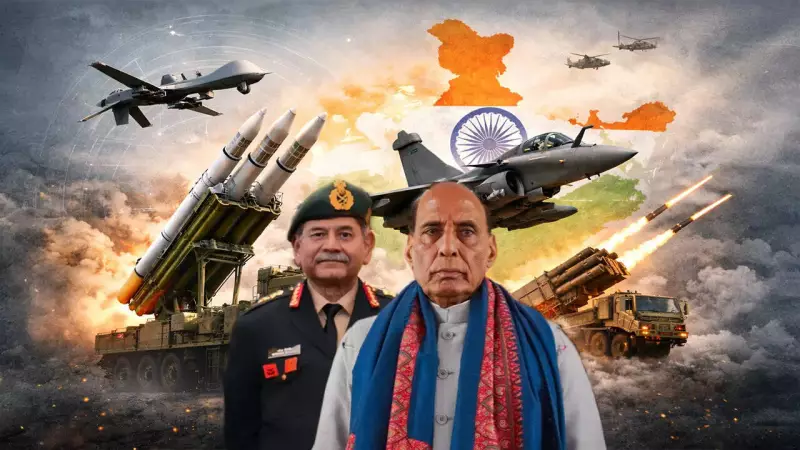
In a decisive move to bolster its military readiness against a challenging security backdrop, India has greenlit a massive modernisation drive worth nearly Rs 79,000 crore. The approvals, granted by the Defence Acquisition Council (DAC) chaired by Defence Minister Rajnath Singh, encompass a wide spectrum of critical systems from air defence missiles and combat drones to long-range rockets and aerial refuellers.
Strategic Imperative: Countering a Two-Front Threat Environment
The sweeping clearances come amid a tightening security environment shaped by a militarily assertive China and a volatile Pakistan. Senior military officials have consistently warned that future conflicts will be defined by speed, precision, and multi-domain warfare capabilities. Air Chief Marshal AP Singh recently emphasised that the timely induction of such capabilities is essential to maintain operational readiness in this rapidly evolving threat landscape.
While the Acceptance of Necessity (AoN) is the first formal step in the procurement process, it firmly establishes the armed forces' requirements and sets the stage for tenders, trials, and negotiations. Collectively, these approvals reveal how India's armed forces are recalibrating for future wars, which may involve drone swarms, long-range missile strikes, and sustained electronic warfare.

Key Acquisitions: Building a Layered Defence and Strike Capability
The modernisation plan reflects a pragmatic blend of indigenous development and strategic imports under the 'Make in India with partners' approach. Here are the major systems approved:
Barak-8 Missiles (Rs 30,000 crore): The single largest approval is for a significant number of Barak-8 medium-range surface-to-air missiles for the Indian Air Force and Navy. This Indo-Israeli system, with an interception range exceeding 70 km, forms the backbone of India's medium-tier air defence. It proved its mettle during the 2019 cross-border hostilities with Pakistan. The procurement aims to bolster missile stocks for sustained engagements.
MQ-9B Predator Drones (Rs 1,600 crore lease): The DAC cleared the lease of two additional MQ-9B high-altitude, long-endurance drones for the Navy for three years. These drones, capable of flying over 30 hours, will bridge a critical surveillance gap until the delivery of 31 armed MQ-9Bs under a $3.8 billion deal with the US, expected only in 2029–30.
Mid-Air Refuelling Aircraft (Over Rs 9,000 crore): In a move to extend the IAF's combat reach, the council approved the acquisition of six mid-air refuelling aircraft. Israel Aerospace Industries will convert six second-hand Boeing 767 aircraft into tankers. This capability is vital for deep-penetration strikes and sustained patrols, especially as China and Pakistan enhance their own refuelling fleets.
Indigenous Missile Push – Astra Mk-2 & Mk-3: The DAC cleared projects to enhance India's air combat prowess. The Astra Mk-2 missile's range is being extended from 100 km to around 200 km, with the IAF likely to order 600–700 units. Work is also underway on the Astra Mk-3, targeting a range of approximately 350 km for long-range interception.
Pinaka Rocket Range Extension: India's artillery firepower is set for a major leap. The range of Pinaka guided rockets is being extended from 75 km to 120 km, with future plans to achieve a 300 km range. A 300-km variant would allow deep strikes into enemy territory without relying solely on air power.
Filling Immediate Gaps and Future-Proofing the Forces
The council also approved several other crucial systems to address immediate operational needs and emerging threats.
This includes additional Meteor beyond-visual-range air-to-air missiles and SPICE-1000 precision-guided bomb kits for the Rafale fighter jets, enhancing their stand-off strike capability.

In a significant move for the Army, the DAC cleared the procurement of 850 indigenously made kamikaze drones (loitering munitions) at a cost of around Rs 2,000 crore for new artillery units. These systems, inspired by recent conflict lessons, provide precision strike capability against enemy armour and positions.
To counter the growing threat of drone swarms, the indigenous Integrated Drone Detection and Interdiction System (IDD&IS) Mark-2 with 30-kilowatt lasers was approved. It can neutralise drones up to 3.5 km away.
Beyond new acquisitions, the DAC also approved overhauls of Mi-17 helicopters in Russia and T-90S tanks in India to extend their service life. Several enabling projects like lightweight radars, naval tugs, flight simulators, and secure software-defined radios were also cleared.
This Rs 79,000 crore modernisation push is not merely a list of acquisitions but a strategic blueprint. It underscores a systems-based approach focused on layered air defence, long-range precision strikes, persistent surveillance, unmanned systems, and electronic resilience to deter and, if necessary, fight high-intensity conflicts in the coming decade.





