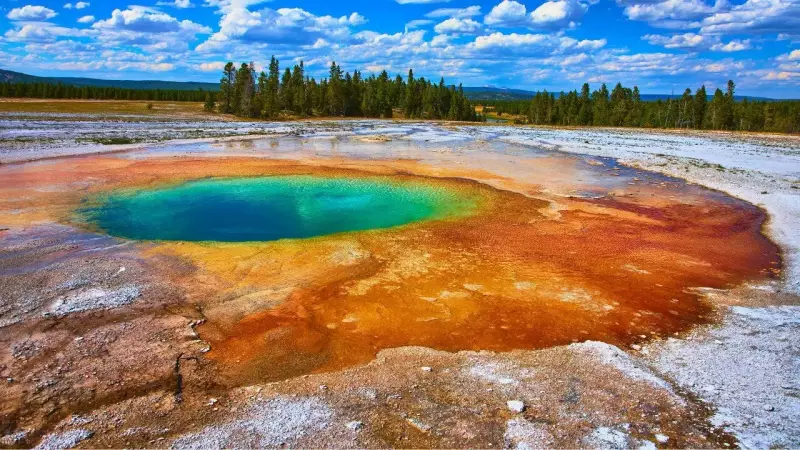
Beneath the stunning forests, geysers, and valleys of Yellowstone National Park lies one of Earth's most powerful and extensively studied volcanic systems. This vast accumulation of heat, fluids, and partially molten rock has been shaping the American landscape for over two million years. As scientific techniques advance, researchers are peeling back the layers of this geological giant, uncovering a history that connects deep Earth processes to global timelines.
The Rhythmic Fury: Yellowstone's Eruption Cycles
The story of the Yellowstone Volcanic Field is written in a sequence of colossal, caldera-forming explosions punctuated by smaller lava flows. Three definitive super-eruptions have been identified, occurring approximately 2.08 million, 1.30 million, and 0.63 million years ago. Each cataclysmic event expelled enormous volumes of rhyolitic magma, causing the ground to collapse and creating calderas tens of kilometres wide.
Recent high-precision dating has revolutionised our understanding of these cycles. Scientists now believe the first complete volcanic cycle—encompassing the build-up, eruption, and partial recharge of magma—unfolded over a geologically brief span of roughly 200,000 years. This is much shorter than previously assumed. The pattern reveals a system that pulses with activity, alternating between eruptive phases and quiet intervals lasting tens of thousands of years, leaving a scattered geological record across Wyoming, Idaho, and Montana.

Beneath the Surface: Magma Storage and Renewal
Contrary to a simple image of a giant lake of molten rock, Yellowstone's magma is stored in a complex, multi-tiered system. Geophysical studies show it resides in zones of crystal-rich mush, with melt distributed in pockets at various depths. This system extends from the crust down into the upper mantle, sustained by heat from below.
The timing of smaller eruptions provides crucial clues. After the first caldera-forming event, new magma reached the surface within about 100,000 years, with later eruptions following even faster. This indicates that some batches of magma can recharge and be ready for eruption in less than 40,000 years—a blink of an eye in geological time. The ongoing heat and movement detected today are not signs of an impending doom but evidence of a long-lived, dynamic system capable of rapid reorganisation after major events.
A Magnetic Time Capsule: Yellowstone's Record of Earth's Past
Yellowstone's volcanic rocks serve as a vital archive for Earth's geomagnetic history. As lava cools, magnetic minerals within it lock in the direction of Earth's magnetic field at that moment. A study in Earth and Planetary Science Letters used lava flows from Yellowstone's first volcanic period to pinpoint a turbulent time within the Matuyama chron.
These flows captured both normal and reversed magnetic polarities, providing a critical terrestrial marker. This data helped refine the timing of the Olduvai subchron and correlates with records in marine sediments. This connection is profound because the global geomagnetic timescale is used to date sediments and fossils worldwide, including sites crucial for understanding early human evolution. Thus, Yellowstone's fire directly ties into the framework of planetary history.
What the Past Tells Us About Yellowstone's Future
Public fascination often fixates on the possibility of a future super-eruption. However, science offers a more nuanced view by examining the system's past behaviour, which shows variability, not strict regularity. Later volcanic cycles lasted longer than the first, with activity spanning several hundred thousand years and including prolonged quiet periods.
The most recent caldera-forming eruption was over 600,000 years ago, followed by rhyolitic flows that continued until about 75,000 years ago. Current measurements of ground deformation, earthquakes, and gas emissions confirm Yellowstone is an active system with moving magma and fluids. Yet, these signs do not forecast a single catastrophic outcome.

The true awe of Yellowstone lies in this revelation: enormous, continuous geological forces operate beneath a landscape synonymous with tranquillity and beauty. Science dispels myths of imminent threat, replacing them with a humbling view of a dynamic planet. The history preserved in Yellowstone's rocks, magnetism, and timelines offers an unparalleled window into the inner workings of our Earth.