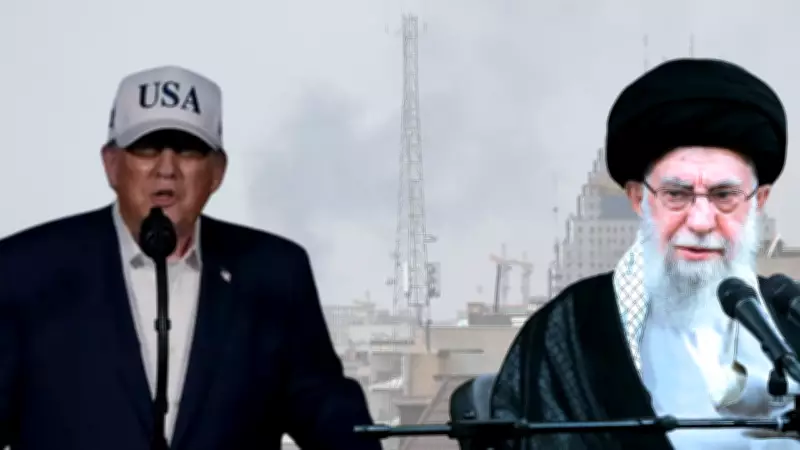
Middle East Plunges Into Crisis After US-Israel Strike Kills Iran's Supreme Leader
The Middle East is facing its most volatile moment in decades following a dramatic announcement by former US President Donald Trump. In a post on Truth Social, Trump declared that Iran's Supreme Leader Ayatollah Ali Khamenei had been killed in a joint US-Israel military strike on Tehran. This unprecedented action has triggered immediate and massive retaliation from Iran, pushing the region to the brink of full-scale war.
The Decapitation Strike and Immediate Fallout
Trump's social media post stated: "Khamenei, one of the most evil people in History, is dead." He claimed the 86-year-old cleric was tracked using "Highly Sophisticated Tracking Systems" and described the assassination as "the single greatest chance for the Iranian people to take back their Country." Israeli Prime Minister Benjamin Netanyahu corroborated the development, saying there were "many signs" that the Iranian leader was "no more."
Iran has not formally confirmed Khamenei's death, but senior official Ali Larijani issued a stern warning that the United States and Israel would "regret their actions," vowing an "unforgettable lesson" from Iran's armed forces. Within hours, this threat materialized as Iran launched Operation Truthful Promise 4, firing waves of missiles and Shahed drones at Israel and multiple US military installations across the Gulf region.

How the Attack Unfolded and Leadership Vacuum
The strikes began around 09:30 Tehran time, with explosions reported near Khamenei's heavily guarded Leadership House compound. Satellite imagery showed blackened buildings and debris within a kilometer of the site. Israeli officials later confirmed the compound had been destroyed in what they described as a "powerful, surprise strike." Trump acknowledged US participation, stating the operation aimed to eliminate "imminent threats" from the Iranian regime.
If confirmed, Khamenei's death would mark the first killing of a sitting Iranian supreme leader and the most direct US intervention in Iran's leadership structure since the 1979 Islamic Revolution. Khamenei had ruled since 1989, succeeding Ayatollah Ruhollah Khomeini, and over nearly four decades consolidated power over:
- The clerical establishment
- The judiciary system
- The armed forces and Revolutionary Guard
There is no publicly confirmed successor, creating a dangerous leadership vacuum. Constitutionally, a panel of clerics selects the next supreme leader, but analysts warn that in wartime, power could shift to a temporary council or directly to the Islamic Revolutionary Guard Corps (IRGC). The absence of a clear transition plan risks internal rivalries that could destabilize the political system Khamenei spent decades fortifying.
Iran's Massive Retaliation and Regional Impact
Iran's Islamic Revolutionary Guard Corps launched Operation Truthful Promise 4, targeting Israel and five major US facilities in Qatar, Bahrain, Kuwait, Jordan, and the UAE. The attacks included:
- Approximately 150 ballistic missiles launched toward Israel
- Multiple waves of Shahed drones
- Strikes on US Navy's Fifth Fleet headquarters in Bahrain
- Attacks on Al Udeid airbase in Qatar and Ali Al Salem airbase in Kuwait
US Central Command reported defending against "hundreds" of incoming missiles and drones, with no fatalities and only minimal damage to US assets. However, footage showed explosions near strategic installations, highlighting vulnerabilities despite advanced air defense systems like Patriot and THAAD.
Civilian Casualties and Humanitarian Crisis
The human cost has been devastating. Iranian state media reported at least 201 people killed and more than 700 injured in the initial strikes across 24 provinces. Among the dead were reportedly dozens of schoolgirls in Hormozgan province, though independent verification remains limited.

In the Gulf region, falling debris and drone strikes injured civilians in Kuwait and the UAE. A luxury hotel in Dubai caught fire following an explosion nearby. Regional governments condemned the attacks as violations of sovereignty while confirming they had intercepted incoming projectiles.
Political Calculations and Global Implications
Trump went beyond military objectives, openly urging Iranians to overthrow their government. In a video address, he stated: "When we are finished, take over your government. It will be yours to take." He offered Iranian armed forces "complete immunity" if they laid down weapons, warning others would face "certain death." This rhetoric signals Washington sees strategic opportunity in Khamenei's removal, though critics argue it risks inflaming nationalist sentiment and uniting Iranian factions.
Netanyahu described the strike as eliminating an "existential threat" to Israel. Israeli officials claimed around 200 fighter jets dropped hundreds of munitions on roughly 500 targets, including missile launchers, IRGC command centers, and air defenses. They also claimed senior Iranian defense figures were killed in the operation.
Economic Shockwaves and What Comes Next
The Strait of Hormuz, through which roughly one-fifth of global oil shipments pass, has become a critical flashpoint. Iranian forces reportedly warned vessels against transiting the waterway. Airlines suspended flights across the Gulf, and several countries partially closed their airspace. Markets reacted nervously amid fears of prolonged disruption, with any sustained closure of Hormuz likely to send energy prices soaring and strain global supply chains.
The immediate future depends on several critical factors:
- Official confirmation of Khamenei's death
- Who consolidates power in Tehran's leadership vacuum
- Whether the IRGC assumes more overt governing authority
- Potential for further escalation between regional powers
This crisis represents the most dangerous escalation in Middle East tensions in generations, with implications that will reverberate across global politics, economics, and security for years to come.