

US-Iran Tensions Sharply Escalate Amid Military Buildup and Nuclear Deal Ultimatum
Tensions between the United States and Iran have dramatically intensified following a stark warning from US President Donald Trump. The President has demanded that Tehran negotiate a nuclear agreement or confront military action described as "far worse" than Operation Midnight Hammer. This ultimatum comes as a "massive armada" of US naval forces advances into West Asia, heightening fears of an imminent military confrontation.
Trump's Direct Warning and Iran's Defiant Response
President Trump has repeatedly urged Iran to "come to the table" for what he terms an "equitable" deal, explicitly stating there should be "no nuclear weapons." On Wednesday, he escalated his rhetoric with a fresh warning, announcing that a "massive Armada" is heading towards Iran.
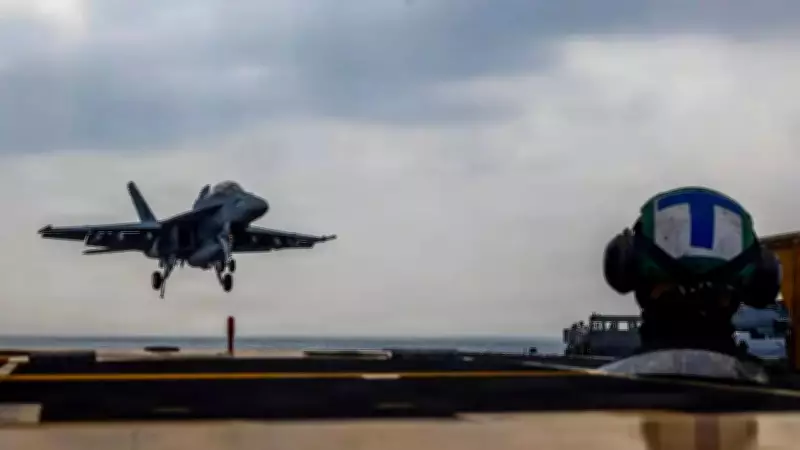
"A massive Armada is heading to Iran. It is moving quickly, with great power, enthusiasm, and purpose," Trump declared in a post on Truth Social. He emphasized that the fleet, spearheaded by the aircraft carrier USS Abraham Lincoln, is "ready, willing, and able to rapidly fulfill its mission, with speed and violence, if necessary." Adding a grave caution, he stated, "The next attack will be far worse! Don’t make that happen again."

Iran’s mission to the United Nations responded by asserting that Tehran "stands ready for dialogue based on mutual respect and interests." However, it also issued a sharp counter-warning: if provoked, Iran "WILL DEFEND ITSELF AND RESPOND LIKE NEVER BEFORE." Trump has frequently threatened military action against Iran, citing its treatment of civilians during a civil uprising that began last month and has reportedly resulted in thousands of deaths.
US Military Moves into West Asia with Enhanced Capabilities
Shortly after Trump’s remarks, the US confirmed increased military activity in the region. The US Central Command (CENTCOM) announced that the USS Abraham Lincoln Carrier Strike Group has entered its area of responsibility after being redirected from the Indo-Pacific.
This Nimitz-class nuclear-powered aircraft carrier is accompanied by Arleigh Burke-class destroyers:
- USS Frank E Petersen Jr
- USS Spruance
- USS Michael Murphy
This deployment significantly enhances Washington's strike capabilities in the region. CENTCOM also revealed plans for military exercises in West Asia to demonstrate the ability to "deploy, disperse, and sustain combat airpower," though specifics on location and duration were not provided.
In addition to naval assets, the Pentagon is mobilizing fighter jets and air defence systems to the Middle East. These include:
- F-35C and F/A-18 fighter jets
- EA-18 Growler electronic warfare aircraft
- F-15E Strike Eagles deployed to regional bases
According to a Wall Street Journal report, the US is also transferring Patriot and THAAD air defence systems to protect American forces and allies from potential Iranian counterattacks. Trump had earlier remarked on Friday, "We have a lot of ships going that direction, just in case. I’d rather not see anything happen, but we’re watching them very closely."
Decoding the Firepower of Trump's 'Beautiful Armada'
The USS Abraham Lincoln stands as one of the US Navy’s most formidable aircraft carriers. Commissioned on November 11, 1989, in Norfolk, Virginia, its first major deployment occurred in May 1991 following Iraq’s invasion of Kuwait, though it was diverted to support evacuation operations after the eruption of Mount Pinatubo in the Philippines.
Advanced Aircraft and Systems in the Fleet
F-15E Strike Eagle: This dual-role fighter is designed for both air-to-air and air-to-ground missions. Equipped with advanced avionics, it operates effectively at low altitudes, day or night, and in all weather conditions. Its navigation system combines a laser gyro and GPS for precise tracking, while the APG-70 radar enables long-range detection of ground targets. The LANTIRN system facilitates low-altitude night flying and precision strikes.

F-35C Lightning II: As the US Navy’s first and only fifth-generation stealth fighter tailored for aircraft carrier operations, the F-35C offers unmatched stealth, sensor fusion, and situational awareness. It has proven its combat capability by playing a key role in suppressing Iran’s air defences during Operation Midnight Hammer and logging nearly 5,000 mishap-free flight hours during a US Marine Corps deployment.
F/A-18 Super Hornet: This multirole strike fighter forms the backbone of US Navy carrier air wings, featuring advanced avionics, AESA radar, and networked combat capabilities.
EA-18G Growler: A specialised electronic warfare aircraft that jams enemy radars, disrupts communications, and suppresses air defences, crucial for strike operations against heavily defended targets.
Seahawk Helicopters: The MH-60R and MH-60S Seahawks serve as the US Navy’s primary multi-mission helicopters, used for anti-submarine warfare, surface combat, and logistics support.
Nuclear-Powered Submarines: The US Navy operates a vast fleet of nuclear-powered submarines, providing stealth, long-range strike capability, and undersea dominance—key elements of US naval power projection.
Regional Implications and Escalating Stances
The arrival of the USS Abraham Lincoln carrier strike group, bolstered by advanced fighter jets, electronic warfare aircraft, helicopters, and nuclear-powered submarines, equips Washington with the capability to execute swift and decisive military operations. This development occurs even as Gulf Arab states have indicated they do not wish to be drawn into a conflict, despite hosting American forces. Concurrently, Iranian-backed militias in the region have signaled readiness to carry out new attacks, potentially escalating tensions further as both sides harden their positions.





