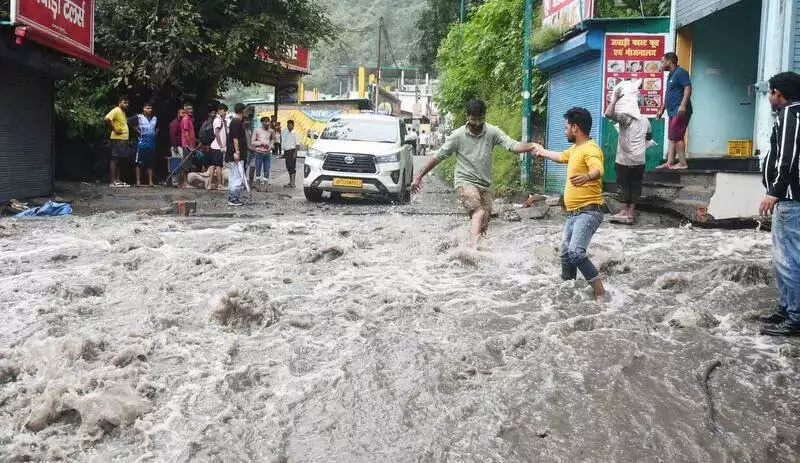
A groundbreaking study has uncovered that the hidden, subsurface characteristics of the Indian Ocean are a critical driver behind the highly variable speed of the Indian summer monsoon's advance across the subcontinent. Published in the January 2026 issue of Mausam, the journal of the India Meteorological Department (IMD), the research provides a scientific explanation for extreme variations, such as the monsoon taking 78 days to cover India in 2002 versus a swift 25 days in 2005.
The Hidden Drivers Beneath the Waves
The research team, comprising Dinesh K Yadav, B Mandal, Sanjay Bist, and Rajeev Bhatla from Banaras Hindu University (BHU) and IMD Delhi, analysed potential temperature and salinity patterns at depths between 5 metres and 105 metres across five key regions of the Indian Ocean. They focused on the pre-monsoon and early monsoon months. Their investigation revealed stark contrasts between a slow year like 2002 and a fast year like 2005, which had an average advancement period of 41 days.
The study concluded that greater evaporation in 2005 led to higher subsurface salinity and more persistent warm layers. When combined with stronger wind patterns, these conditions significantly enhanced moisture availability and transport, creating a far more favourable environment for the monsoon to race across the country. The opposite conditions in 2002 contributed to major delays.

Salinity and Temperature: A Tale of Two Years
Along the Kerala coast, the upper subsurface waters (5–25 m) during March–April–May 2002 showed low salinity, below 34 Practical Salinity Units (PSU). In 2005, salinity in the same layer exceeded 34.5 PSU, indicating stronger evaporation and conditions that favour higher moisture flux to the atmosphere.
In the Arabian Sea, a peak salinity of 36.3 PSU was recorded between 50 m and 80 m in 2002. In 2005, this same high salinity value was found deeper, between 55 m and 90 m. This vertical shift reflects stronger evaporation and altered mixing processes. In the Bay of Bengal, salinity declined more rapidly in 2002 than in 2005. This increased the contrast between the saltier Arabian Sea and the fresher Bay of Bengal, a factor linked by researchers to weaker moisture transport and a slower monsoon.
Subsurface temperatures also played a crucial role. While peak temperatures of around 31°C were observed down to 20 m in both years, their persistence differed. In 2002, peak temperatures appeared earlier and dissipated faster. In 2005, they developed slightly later but lasted longer, particularly in the Arabian Sea and Bay of Bengal, sustaining evaporation over a longer period.
The Amplifying Role of Wind
Wind patterns further amplified these oceanic effects. In July 2005, stronger south-westerly winds at the 850 hPa level were observed over the Arabian Sea and along the Somalia coast compared to 2002. These stronger winds acted as a conveyor belt, transporting the available moisture more efficiently across India, allowing rainfall systems to advance rapidly.
Implications for Future Monsoon Forecasting
The authors stated, "The contrast in temperature and salinity between the Arabian Sea and the Bay of Bengal was observed to be higher in fast-advancement years... Wind also plays a crucial role in transporting moisture all over India." While sea surface temperatures have long been monitored for monsoon clues, this study establishes that subsurface ocean characteristics exert a strong influence on monsoon timing, strength, and duration.
By demonstrating how these hidden ocean signals shape monsoon behaviour, the research underscores an urgent need: to integrate observations from the ocean's interior into operational monsoon forecasting systems. This integration could be a vital step towards improving early warnings for delayed or sluggish monsoons in the future, offering significant benefits for agriculture, water management, and disaster preparedness across India.