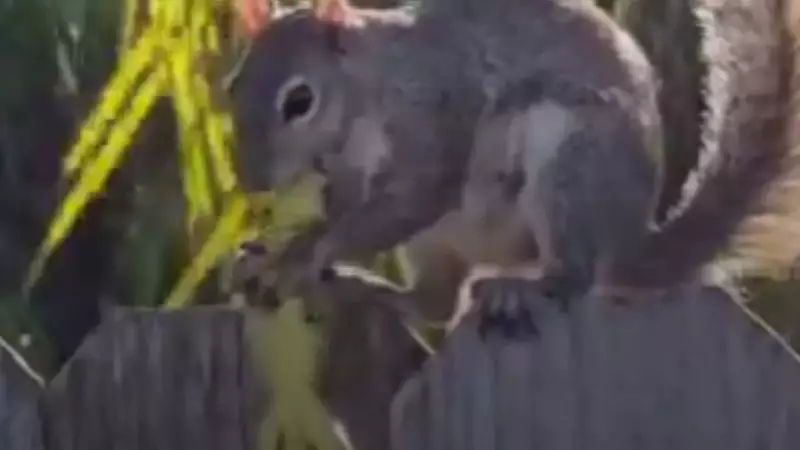
In a discovery that has stunned wildlife biologists, the familiar California ground squirrel, often seen nibbling peacefully on seeds in backyards, has been documented as an active predator. A groundbreaking study has revealed these bushy-tailed rodents hunting, killing, and consuming other animals, specifically voles, upending decades of scientific understanding.
From Seed-Eaters to Opportunistic Hunters
For a long time, scientists classified California ground squirrels as strictly granivorous, meaning their diet was believed to consist almost entirely of plant-based foods like seeds and nuts. However, a joint research project by the University of Wisconsin-Eau Claire and the University of California, Davis, has turned this assumption on its head. The study, published in Springer Nature, shows these squirrels are actually opportunistic omnivores capable of preying on small mammals when the chance arises.
The shocking behaviour was first spotted by undergraduate students conducting fieldwork in local Californian parks. Jennifer E. Smith, the lead researcher and an associate professor of biology at UW-Eau Claire, expressed her surprise. "We had never seen this behaviour before," Smith said. "Squirrels are one of the most familiar animals to people. Yet here was a completely new behaviour, revealing that there's still so much to learn about even the most common creatures around us."

Documenting the Carnivorous Turn
The researchers closely monitored squirrel interactions from June 10 to July 30. Their observations yielded startling data: out of 74 recorded interactions, a significant 42% involved direct predation on voles. This active hunting was particularly pronounced during periods when vole populations were at their peak, suggesting that food availability is a major driver behind this dietary shift.
Sonja Wild, a postdoctoral research fellow at UC Davis, compared the squirrels' adaptability to other known opportunists. "These squirrels are incredible opportunists," Wild noted. "When food availability changes, they can adapt quickly, exploiting new resources to survive and thrive." This flexibility mirrors the behaviour of raccoons, coyotes, and even humans.
Ecological Implications and Future Questions
This discovery fundamentally alters the perceived ecological role of the California ground squirrel. They are no longer seen just as harmless foragers but as dynamic players that can influence local vole populations and compete with other predators. By turning to voles, the squirrels gain access to a rich protein source, which may be crucial during times of scarce vegetation or high competition.
The study opens several new avenues for research. Scientists are now curious about:
- How frequently this hunting behaviour occurs.
- Whether it is a seasonal activity tied to vole population cycles.
- If there is a hereditary component to this predatory tendency.
This newfound behavioural flexibility might be a key survival trait in landscapes increasingly altered by human activity. As traditional food sources change, the ability to switch diets could ensure the persistence of this common species. The humble backyard squirrel, it seems, has a far more complex and surprising life than anyone imagined.