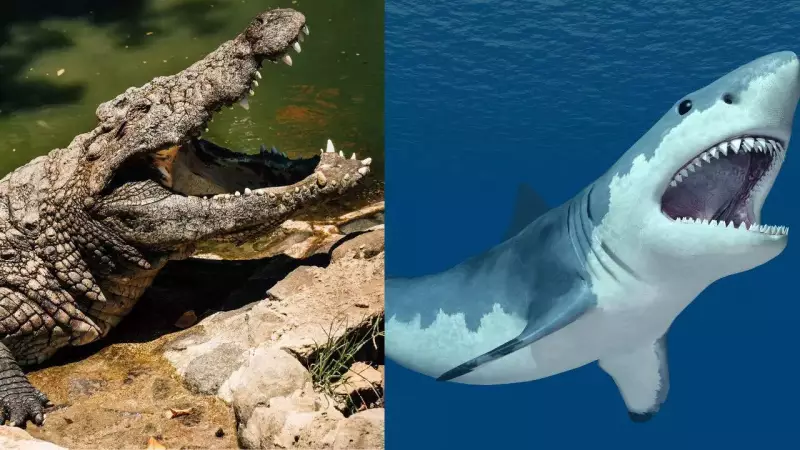
In the realm of nature's most formidable hunters, the shark and the crocodile reign supreme. These apex predators, sitting at the very top of their respective food chains, have inspired both awe and fear for millennia. Remarkably evolution-conservative, they have survived mass extinctions with minimal change, a testament to their deadly perfection. While their paths seldom cross due to differing habitat preferences, river mouths, estuaries, and coastal waters can become unlikely battlegrounds. When they do meet, the clash is nothing short of extraordinary. By examining their physical traits, hunting tactics, and combat skills, we can predict the outcome of this mythical duel.
Key Differences: Shark and Crocodile Compared
To understand how a confrontation might unfold, a side-by-side comparison of their biological and combat attributes is essential. Both are colossal, but their strengths are honed for different worlds.
Size and Strength: While large saltwater crocodiles can weigh over 2,300 kg, the great white shark holds a decisive mass advantage, with some individuals estimated at a staggering 5,000 kg. In deep water, buoyancy allows the shark to utilise its full size without restraint. Crocodiles possess immense explosive power but lack the stamina for prolonged aquatic battles.

Speed and Agility: This is where the shark dominates. Built as continuous swimmers, sharks like the great white can reach speeds of up to 55 km/h and accelerate with terrifying bursts. Crocodiles, adept at brief, explosive movements, are good swimmers but cannot match the shark's sustained speed and agility in open water, putting them at a tactical disadvantage.
Weapons and Tactics: Bite Force vs. Slicing Teeth
The nature of their attack is a critical differentiator. A crocodile's bite is a crushing force, one of the most powerful on Earth, measuring up to 3,700 PSI. Its thick, conical teeth are designed for gripping and holding prey, often leading to a fatal death roll.
In contrast, a shark's bite, while also immensely powerful (estimated up to 4,000 PSI), relies on serrated, razor-sharp teeth meant for slicing. This causes massive tissue damage and rapid blood loss. Even a single powerful bite from a crocodile may not be as immediately lethal as the shark's repeated, slicing attacks.
Sensory Edge and Defensive Armour
Sharks possess arguably the most advanced sensory suite in the animal kingdom. Their ability to detect minute electrical signals (electroreception) and trace amounts of blood gives them a huge detection advantage. The crocodile would likely be sensed first.
Defensively, the crocodile has a major benefit: its thick, armoured skin, especially on the back, provides significant protection against bites. Sharks lack this bony armour but compensate with constant motion and agility, making them harder to target. However, a crocodile's vulnerable underbelly and head remain exposed.
The Final Verdict: Environment is King
So, who would win in a fight between a shark and a crocodile? The answer is profoundly influenced by one factor: the environment.
In open or deep water, the shark's superior speed, mobility, size advantage, and slicing bite would likely overwhelm the crocodile. The shark could control the engagement, launching repeated attacks.
However, in shallow coastal waters, river mouths, or near land, the tide turns. Here, the crocodile's ambush prowess comes to the fore. It could launch a surprise attack, secure a crippling grip, and execute its devastating death roll, potentially defeating the shark.
Both are perfectly adapted masters of their domains. Their hypothetical battle is less about absolute dominance and more about location, timing, and the element of surprise. In a majority of open-water scenarios, the shark holds the edge, but never underestimate the crocodile's lethal ambush in its own murky, shallow territory.