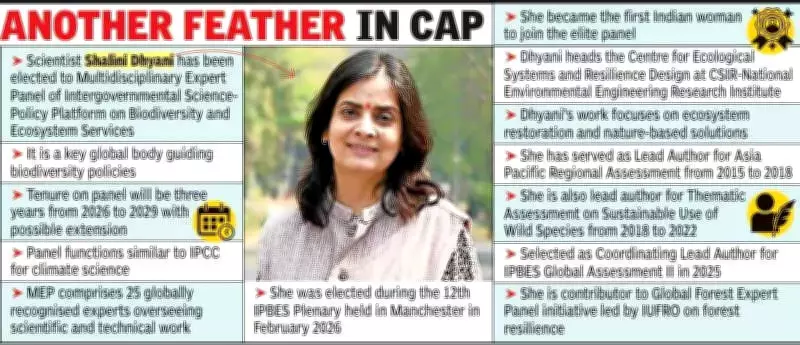
Indian Scientist Shalini Dhyani Makes History with Election to Global Biodiversity Panel
In a significant development for India's scientific community, noted scientist Shalini Dhyani has been elected to the Multidisciplinary Expert Panel (MEP) of the Intergovernmental Science-Policy Platform on Biodiversity and Ecosystem Services (IPBES). This prestigious global body plays a crucial role in guiding international biodiversity policies and frameworks.
Historic Achievement for Indian Science
Dhyani's election occurred during the 12th IPBES Plenary held in Manchester in February 2026, marking her as the first Indian woman to join this influential panel. With over two decades of dedicated research focused on forest ecosystem conservation, Dhyani brings extensive expertise to this global platform.
Currently serving as the head of the Centre for Ecological Systems and Resilience Design at CSIR-National Environmental Engineering Research Institute (NEERI), Dhyani emphasized that "India's voice is vital in shaping global environmental negotiations, particularly as a representative of the Global South."

India's Unique Ecological Perspective
Dhyani highlighted India's remarkable ecological diversity, which encompasses 16 major forest types and hundreds of sub-types, providing unique insights into balancing conservation with development. "What works in the Global North may not always be feasible here. Bridging that gap is essential," she noted, underscoring the need for context-specific approaches.
The scientist identified several pressing challenges facing ecosystems:
- Growing threats from invasive species like water hyacinth and lantana
- Increasing pressures from climate change
- Ongoing developmental demands
"We cannot adopt a one-size-fits-all approach. Solutions must be tailored to local landscapes and ecosystems," Dhyani asserted, advocating for site-specific and scalable interventions.
Integrating Traditional Knowledge with Modern Science
A strong proponent of combining indigenous wisdom with contemporary scientific methods, Dhyani stressed that traditional knowledge systems, refined over generations, hold immense value for conservation efforts. "Science brings evidence and innovation, but traditional knowledge offers time-tested solutions. Combining both can be transformative," she explained, aligning with IPBES's emphasis on inclusive knowledge systems.
Focus on Ecosystem Restoration and Citizen Science
Dhyani's research primarily centers on ecosystem restoration and nature-based solutions, which she directly links to improving quality of life. She also highlighted India's emergence as a hub for "citizen science," where individuals contribute valuable long-term biodiversity data. "If people understand their local ecosystems, they are more likely to protect them," she observed.
Future Objectives and Global Impact
Looking forward, Dhyani aims to ensure that India's scientific perspectives and socio-ecological realities are adequately reflected in global policy frameworks while simultaneously learning from international experts. "It's an opportunity not just to contribute, but to bring back global learnings to strengthen our national efforts," she added, expressing optimism about the mutual benefits of this international collaboration.
This election represents a significant milestone for Indian environmental science and reinforces the country's growing influence in global biodiversity conservation discussions.