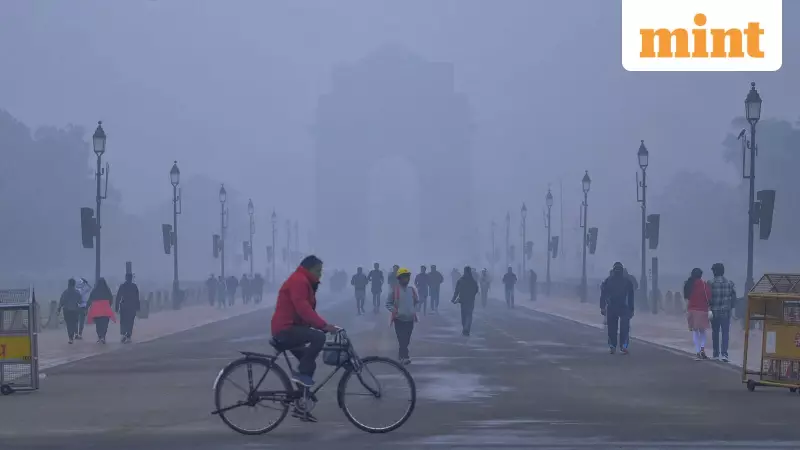
Thick, hazardous smog made a menacing return to the Delhi-National Capital Region (NCR) on Saturday morning, plunging air quality back into the 'Severe' category across multiple locations. The brief respite from toxic air that residents experienced earlier in the week was decisively over.
Air Quality Plummets, Visibility Drops
The average Air Quality Index (AQI) for the city was recorded at 359 at 11:05 AM, which falls under the 'Very poor' classification. However, the situation was significantly worse in several pockets. The relief period, driven by favourable winds, had ended on 26 December when the city's AQI was 333, with PM10 and PM2.5 particles as the primary pollutants.
The dense layer of smog drastically reduced visibility, disrupting daily life and creating chaos for travellers. The impact on aviation was severe, with Delhi's Indira Gandhi International Airport reporting that 51% of departures were delayed as of 11:00 AM on Saturday. Data from flight tracking service Flightradar24 indicated the average delay time for departing flights was approximately 17 minutes.

Worst-Hit Areas and GRAP Measures
According to the Central Pollution Control Board (CPCB), seven out of the 40 air monitoring stations in Delhi registered readings in the 'Severe' range. The areas suffering the worst air quality on Saturday were:
- Vivek Vihar - 423
- Anand Vihar - 419
- Jahangirpuri - 419
- Nehru Nagar - 412
- Shadipur - 407
- Wazirpur - 406
- Rohini - 406
Additionally, 24 stations recorded 'Very poor' AQI. In response to the deteriorating conditions, authorities have reinstated Stage III measures of the Graded Response Action Plan (GRAP). Experts point to a combination of cold temperatures, calm winds, and dense fog as the primary reasons for trapping pollutants and creating the smog-like situation.
CAQM's Recent Actions and Forecast
The Commission for Air Quality Management (CAQM) had just relaxed the strictest GRAP Stage IV curbs on 24 December. This decision came after air quality improved from the 'Severe+' category to 'Poor', aided by high wind speeds and better meteorological conditions.
However, the Commission had warned of a potential decline in air quality in the following days. Citing forecasts from the India Meteorological Department (IMD) and IITM, the CAQM noted that slower winds due to western disturbances could lead to a rise in pollution levels. This prediction has now materialised with the current spike.
Beyond the GRAP protocols, local bodies are also taking steps. The New Delhi Municipal Council (NDMC) has recently installed anti-smog guns on top of 13 high-rise buildings in a bid to locally settle dust and particulate matter, though the effectiveness against such widespread pollution remains a challenge.