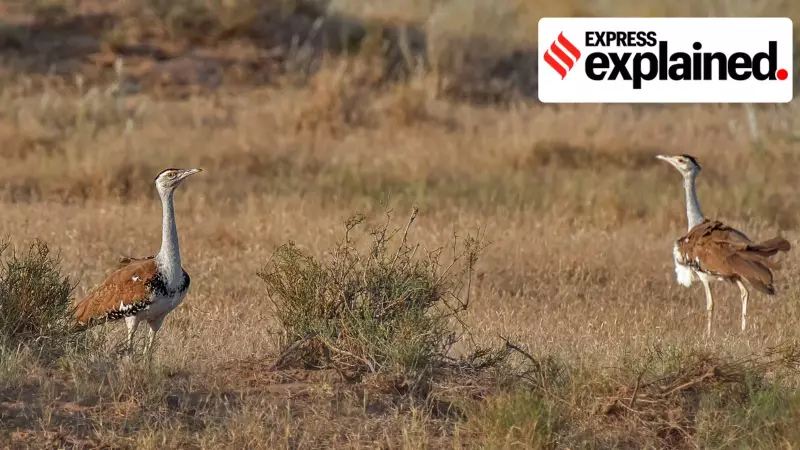
In a landmark ruling aimed at preventing the extinction of a critically endangered species, the Supreme Court of India has issued a series of new directives to protect the Great Indian Bustard (GIB). The judgement, pronounced on December 19, 2025, introduces fresh safeguards to mitigate the bird's fatal collisions with overhead power lines, particularly those linked to renewable energy projects in its key habitats.
The Core Conflict: Bustard Survival vs. Green Energy
The case, initiated in 2019 by environmentalist M K Ranjitsinh, highlighted a tragic paradox. The expansion of solar and wind energy infrastructure in Rajasthan and Gujarat—the two most crucial habitats for the GIB—was inadvertently causing the death of the very birds the clean energy transition aims to protect. With an estimated population of only 150 individuals, each collision with a power line pushed the species closer to the brink.
The GIB's poor frontal vision and heavy body make it exceptionally vulnerable to these linear structures, often failing to detect and manoeuvre around them in time. A 2018 report by the Wildlife Institute of India (WII) had starkly warned that without urgent mitigation, power line mortality would certainly lead to the bird's extinction.

While the Supreme Court had earlier, in 2021, ordered a prohibition on new overhead lines in a vast area and explored undergrounding options, it revisited the issue in March 2024. The court acknowledged the need to balance GIB conservation with India's climate commitments and clean energy goals, noting that blanket undergrounding across such expansive territories was not entirely feasible. This led to the formation of an expert committee to devise a more nuanced solution.
Key Measures Ordered by the Supreme Court
Based on the committee's recommendations, the Supreme Court has now laid down a multi-pronged strategy focused on revised priority areas, dedicated power line corridors, and voltage-based mitigation.
Revised and Expanded Priority Areas: The court has officially redrawn the core conservation zones. In Rajasthan, the 'priority area' has been increased from 13,163 sq km to 14,013 sq km. In Gujarat, it has been expanded from 500 sq km to 740 sq km. These zones, identified through studies by the Rajasthan forest department and WII, are the most important habitats for the bustard's presence and breeding.
Creation of Dedicated Power Line Corridors: A crucial new measure is the establishment of specific corridors to reroute overhead lines away from critical habitats. In Rajasthan, these corridors will be up to 5 km wide and lie at least 5 km south of the Desert National Park. In Gujarat's Kutch region, dedicated corridors of 1–2 km width will be created to evacuate power from coastal wind and solar projects.
Strict Restrictions and Undergrounding Mandates: The court has prohibited new overhead power lines (except for small 11 kV lines) and new wind turbines within the revised priority areas, allowing them only through the designated corridors. It has also banned new solar parks larger than 2 MW and the expansion of existing ones in these zones.
Furthermore, the court ordered the immediate undergrounding of specific power lines. This includes 80 km of 33 kV lines in Rajasthan and 79.2 km of 33 kV lines plus 64.9 km of 66 kV lines in Gujarat. The WII has identified 250 km of critical power lines that must be buried within two years, with all such work to be completed before 2028.
Conservation Efforts and Community Role
Beyond infrastructure changes, the judgement reinforces ongoing conservation efforts under Project GIB. For Rajasthan, the court directed in-situ measures like grassland ecosystem restoration, predator management (targeting free-ranging dogs and egg-eating reptiles), and enhanced community engagement.
For Gujarat, a significant directive involves using a 'jump-start' method. This technique involves swapping infertile eggs in wild nests with fertile eggs from Rajasthan to incubate and raise chicks, bolstering the local population. The court also mandated the tagging of birds with GPS trackers to facilitate this process.

While the judgement has been welcomed as a critical step, some conservationists, like wildlife biologist Sumit Dookia, have expressed concerns. They argue that protection should have been extended to crucial habitats like Degray Oran and that the order remains silent on threats from upcoming limestone mining and cement factories near key zones like Sanu and Parewar.
The Supreme Court's ruling represents a carefully calibrated attempt to secure a future for the Great Indian Bustard without derailing India's renewable energy ambitions. Its success will now depend on the swift and effective implementation of these new safeguards on the ground.