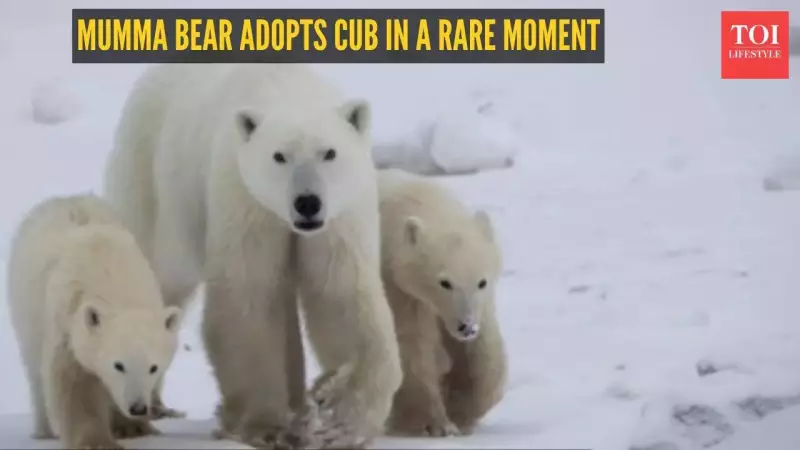
In a rare and heartening event observed in the wild, a female polar bear in northern Canada has adopted an orphaned cub, marking only the 13th such documented case in over four decades of intensive study. The incident, involving bear X33991 in Manitoba, offers a glimmer of hope for a species facing immense pressure from the rapidly warming Arctic.
A Surprising Discovery on the Tundra
The story began in March when researchers observed polar bear X33991 emerging from her maternal den in Wapusk National Park, northeastern Manitoba, with a single cub. The scientists fitted the young bear with an identifying ear tag. The scene shifted dramatically in mid-November near Churchill, Manitoba, a famous polar bear gathering spot. When X33991 was spotted again, she was not alone with her tagged offspring. She was seen moving across the landscape with two cubs in tow—one tagged and one untagged.
This prompted immediate investigation by scientists. Video evidence near Hudson Bay, where hundreds of bears congregate each fall waiting for sea ice, captured the trio. Further analysis confirmed the extraordinary conclusion: X33991 had adopted the second, untagged cub. Both cubs are estimated to be 10 to 11 months old, while the adoptive mother, who wears a GPS tracking collar, is about five years old.

The Mystery and Science of Bear Adoption
The fate of the adopted cub's biological mother remains unknown. Researchers have collected genetic samples from the cub, which may reveal if its mother is a bear already known to science and whether she is still alive. Interestingly, adoption might not always stem from orphaning. Scientists note that polar bear mothers have been known to switch litters or temporarily care for extra cubs.
"There must be some sort of confusion going on," said Evan Richardson, a scientist with Environment and Climate Change Canada, in a video statement. "But we really think it’s just because they’re so maternally charged and such good mothers and they can’t leave a cub crying on the tundra, so they pick them up and take them along with them."
This behavior, while rare, could be more common than records suggest. Jon Aars, an ecologist at the Norwegian Polar Institute, told The Washington Post that only one adoption has ever been documented in Norway. The survival stakes are incredibly high. Globally, only about 50% of polar bear cubs survive their first year, and for orphans, the chances are nearly zero.
"If a cub becomes orphaned for some reason, it has almost no chance," stated Alysa McCall, a staff scientist with Polar Bears International. "When we got confirmation that this was an adoption, I had a lot of mixed feelings, but mostly good. It gives you a lot of hope when you realize that polar bears maybe are looking out for each other out there."
A Hopeful Act on Thinning Ice
Despite the hopeful narrative, experts urge cautious optimism. Of the 13 known adoption cases within the western Hudson Bay subpopulation—one of the world's most studied bear groups—only three adopted cubs have survived to adulthood, according to reports. Currently, GPS data indicates X33991's small family is doing well, moving across the sea ice of Hudson Bay as expected.
This tender story unfolds against a grim backdrop. Polar bears rely on sea ice to hunt seals, but climate change is causing ice to form later and melt earlier. The Arctic Ocean is warming roughly four times faster than the global average, drastically reducing hunting time for the estimated 26,000 polar bears left in the wild across the Arctic nations.
"The bears need all the help they can get these days with climate change," Richardson emphasized. "If females have the opportunity to pick up another cub and care for it and successfully wean it, it’s a good thing for bears in Churchill." This rare act of adoption is a powerful, natural response to the growing challenges posed by a warming world.