Every morning, long before the sun rises over Pune, a quiet but crucial ritual unfolds at the Central Agro-meteorological Observatory (CAgMO). Around 4:30 AM, meteorologists release a humble rubber balloon, laden with sensitive instruments, into the pre-dawn sky. This daily launch is part of a legacy that has been decoding the atmosphere for over 160 years.
A Legacy Cast in Data and History
Established by the British in 1856, the CAgMO is nestled on the campus of the Agriculture College in Shivajinagar. Surrounded by open fields with the Chaturshringhi hill in the backdrop, it stands as one of the few meteorological observatories worldwide that is more than two centuries old. Its enduring service has earned it a prestigious spot on the World Meteorological Organisation (WMO) list of centennial observatories across the globe.
For over 160 years, this institution has been the silent chronicler of Pune's climate, meticulously recording:

- Temperature and humidity
- Rainfall and cloud conditions
- Radiation and pollution levels
- Dew and wind patterns
The observatory operates on a 24/7 schedule, with a meteorological day calculated from 8:30 AM to 8:30 AM the next day. Critical readings taken at 8:30 AM and 5:30 PM form the backbone of daily and nightly weather forecasts.
The Science of the Skies: From Balloons to Sunshine Recorders
The pre-dawn balloon is a marvel of simple yet effective technology. Weighing about 350 grams and filled with 500 grams of hydrogen, it ascends 25-30 km into the atmosphere. Its sensors transmit real-time data on wind velocity, temperature, and upper-air conditions back to meteorologists monitoring screens on the ground. "We get a 360-degree idea, which helps us improve the accuracy of forecasts," explains meteorologist T C Mohadikar, a veteran with over 35 years of service.
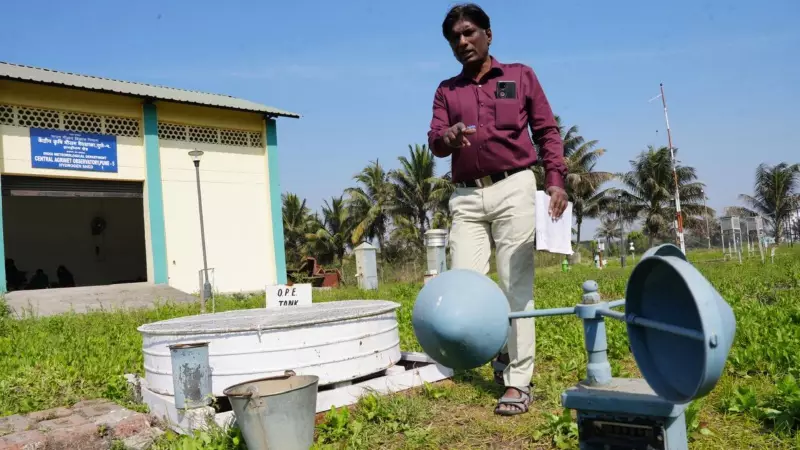
The observatory grounds are an open-air museum of meteorological instruments. Cup counter anemometers measure wind speed at different heights, while wet and dry bulb thermometers gauge humidity. A unique Campbell–Stokes Bright Sunshine Hours Recorder—a glass sphere that focuses sunlight to burn marks on special paper—measures daily sunshine duration, operating on the same principle as a child using a magnifying glass.
Other tools include thermometers buried at various soil depths, a water pool for evaporation studies, and a hair hygrometer. While an Automatic Weather Station with digital sensors represents modern advancement, especially useful for remote areas like the Himalayas, manual recordings by meteorologists making their rounds remain irreplaceable for precision.
Critical Role in National Security and Daily Life
The data from CAgMO transcends academic interest; it plays a vital role in national security and disaster management. During critical periods like the Kargil war or approaching cyclones, the observatory has been in hourly contact with the Indian Air Force stations in Pune. Pilots require precise data on wind speed and direction at 1,000 ft, 2,000 ft, and above for safe take-offs and landings. "It is very important to have accurate data," emphasizes Mohadikar, set to retire in 2026.
Meteorologist Madhukar More notes the seasonal wind patterns observed: Easterlies blow till March, shifting to Westerlies after May, a change that signals the approach of the South West Monsoon. This detailed, localized understanding is what allows forecasters across India to build a complete national weather picture every day at 8:30 AM.
As Pune grows and changes, the Central Agro-meteorological Observatory remains a constant sentinel. Its long-term datasets are invaluable for tracking climate change and understanding micro-climatic shifts. It is a living bridge between a rich scientific heritage and the urgent, data-driven needs of the present, proving that some stories, like the weather itself, require patient, dedicated decoding across centuries.