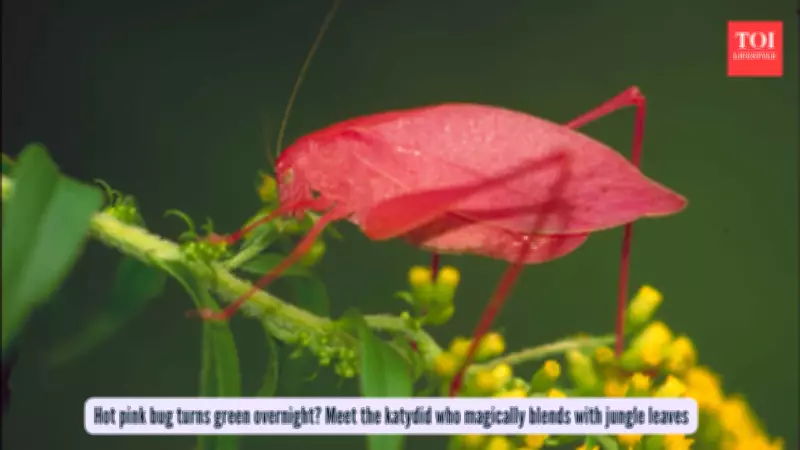
The Pink Katydid's Magical Transformation: A Rainforest Survival Masterclass
Deep within the humid, dense rainforests where every shadow conceals a hunter or the hunted, the art of survival frequently hinges on one critical skill: the ability to disappear. Camouflage is the ultimate weapon in this verdant battlefield, where blending seamlessly with the environment can mean the difference between life and death. Now, imagine an insect boldly displaying a vibrant hot pink hue amidst a sea of endless green foliage. It would appear as nothing less than a walking snack for predators. Yet, in a stunning twist of nature, this very insect performs a slow-motion metamorphosis, shifting its colors to perfectly match its leafy surroundings, leaving researchers utterly astonished.
A Vivid Discovery in Panama's Rainforests
Researchers made an extraordinary observation on Barro Colorado Island in Panama, spotting a strikingly vivid pink adult female Arota festae katydid under artificial lighting. This Neotropical bush cricket, which typically inhabits the rainforests of Panama, Colombia, and Suriname, normally exhibits a light green, leaf-like appearance. However, this particular individual stood out dramatically against its usual camouflage.
Over a period of several days, while kept in a cage with local plants, the 27-millimeter, 1-gram insect began a remarkable transformation. By the fourth day, its hot pink coloration had faded to a pastel shade, and by the eleventh day, it had turned completely green. This gradual change was meticulously documented, revealing a process far more deliberate than a simple genetic anomaly.

The Science Behind the Color Shift
Lead author Dr. Benito Wainwright from the University of St. Andrews, in a study published in Ecology, expressed his amazement: "Finding this individual was a genuine surprise. Because it was so rare, we kept it in natural conditions and found it changing color from hot pink to green." He elaborated that this is not merely a bizarre genetic quirk but likely a finely tuned survival strategy. The katydid's color change appears to track the life cycle of rainforest leaves, which it mimics for protection.
Unlike chameleons, which can change color almost instantly, this katydid's transformation is gradual. This slow shift is believed to enhance its camouflage effectiveness over time, as noted in a study from PMC. The pink phase aligns with what scientists call "delayed greening," a phenomenon observed in over one-third of the island's plants, where young leaves start as red or pink before maturing into green.
Mimicry and Evolutionary Precision
The katydid's diet includes pink-leaved Inga plants, allowing it to blend with abundant new growth. Co-author Dr. Matt Greenwell of the University of Reading highlighted the complexity of tropical forests: "Tropical forests are extraordinarily complex environments, and this discovery hints at just how precisely some animals have evolved to exploit them." He added, "You would think that a bright pink insect in a mostly green forest would stand out to predators like a worker in a high-vis jacket."
Dr. Greenwell further explained, "The idea that an insect might gradually shift color to keep pace with the leaves it mimics shows how dynamic the rainforest can be, and is a remarkable example of camouflage in action." This adaptive polymorphism—where the insect can exist in different color forms—provides a significant survival edge. Past observations had attributed pink coloration to rare erythrism mutations, but this discovery suggests it is an adaptive trait. Another form of the katydid resembles dying leaves, adding to its camouflage repertoire.
A Survival Edge in a Colorful World
Scientific reports, including from Sci. News, confirm that the pink phase acts as "nature's perfect camouflage" in specific contexts. This evolving disguise enables the Arota festae katydid to evade predators amidst the patchy and ever-changing colors of the rainforest. The insect's ability to transition between pink and green phases allows it to remain hidden whether among young, pink foliage or mature, green leaves.

This discovery underscores the incredible adaptability of rainforest species and the sophisticated strategies they employ to survive. It challenges previous assumptions about color mutations and highlights the dynamic interplay between organisms and their environments. As researchers continue to explore these complex ecosystems, such findings remind us of the endless wonders and secrets still hidden within the world's rainforests.