Noida and Ghaziabad Grapple with Deteriorating Air Quality Amid Weather Changes
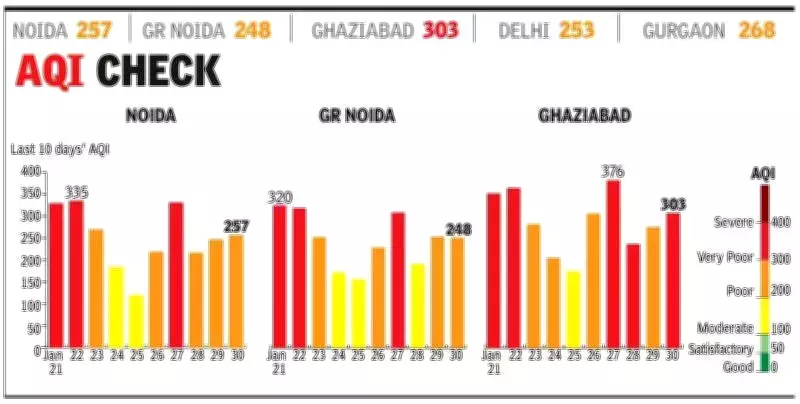
The air quality in Noida continued to hover in the 'poor' category on Friday, with the city recording an air quality index (AQI) of 257. This marked a slight increase from the previous day's AQI of 244, indicating a worsening trend in pollution levels. Meanwhile, the situation in neighbouring Ghaziabad took a more severe turn, as the AQI escalated to the 'very poor' category at 303, up from 272 the day before.
Station-Wise Data Reveals Widespread Pollution Concerns
While official station-wise data from the Central Pollution Control Board portal was unavailable, the Sameer App provided detailed insights into the pollution levels across various monitoring stations. In Noida, all four stations reported air quality in the 'poor' range:
- Sector 1 recorded an AQI of 272
- Sector 116 logged 262
- Sector 62 measured 212
- Sector 125 reported 268
In Greater Noida, the Knowledge Park V station recorded an AQI of 284, while Knowledge Park III registered 208, both falling under the 'poor' category. Ghaziabad's stations showed even more alarming figures, with Loni at 336 and Indirapuram at 309, both in the 'very poor' range. Vasundhara recorded 300 and Sanjay Nagar reported 245, placing them in the 'poor' category.

Weather Forecast and Meteorological Factors
According to forecasts from the India Meteorological Department, the region is likely to experience light rainfall accompanied by thunderstorms today. The Indian Institute of Tropical Meteorology (IITM) reported that surface winds on Friday originated from the northwest direction, reaching speeds of up to 10 kmph during the afternoon hours. However, wind speeds decreased to less than 6 kmph during the evening and night, potentially contributing to the accumulation of pollutants.
For Saturday, the city is expected to witness a partly cloudy sky in the morning, transitioning to a generally cloudy sky towards the afternoon and evening. Isolated areas might experience dense fog in the morning hours, with the possibility of very light rain accompanied by thunderstorms and lightning. Temperature-wise, Friday saw a maximum of 20 degrees Celsius and a minimum of 8 degrees Celsius.
Implications and Regional Context
The persistent 'poor' air quality in Noida and the escalation to 'very poor' in Ghaziabad highlight ongoing environmental challenges in the National Capital Region. These conditions pose health risks, particularly for vulnerable populations, and underscore the need for sustained pollution control measures. The anticipated weather changes, including rainfall and thunderstorms, may offer temporary relief by dispersing pollutants, but long-term solutions remain crucial for improving air quality in these urban areas.