Najafgarh Jheel Ecological Assessment Reveals Critical Stress Factors
A preliminary scientific assessment of Najafgarh jheel, the transboundary wetland spanning Haryana and Delhi, has uncovered significant ecological stress stemming from disrupted drainage connectivity, encroachment pressures, and the presence of globally threatened raptor species. The findings emerged from a comprehensive two-day reconnaissance survey conducted on November 19 and 20, 2025, by a dedicated team from the National Centre for Sustainable Coastal Management (NCSCM).
Scientific Survey Methodology and Key Findings
The NCSCM team, comprising Dr Subbareddy Bonthu and Dr Hariharan G, collaborated with officials from Delhi's irrigation and flood control department and Haryana's GMDA to execute GPS-based ground mapping, visual documentation, and qualitative assessment of land use and biodiversity. This meticulous exercise aimed to delineate the wetland's hydrological and ecological boundaries with precision.
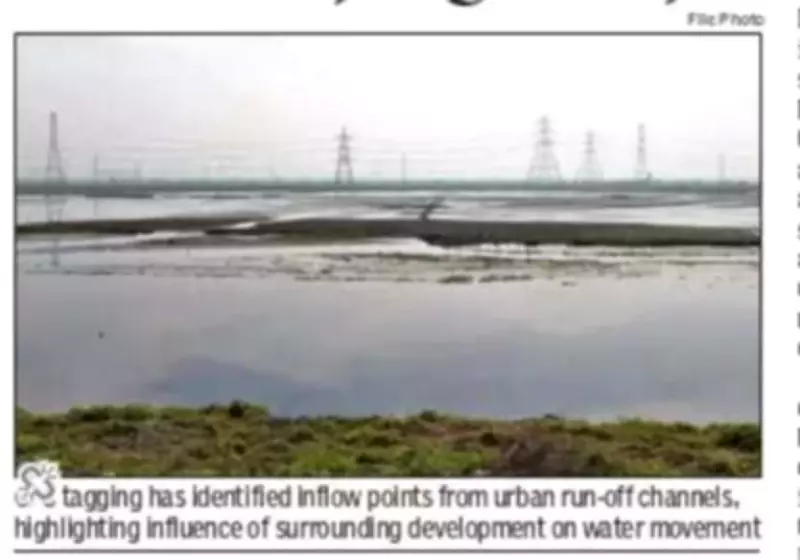
The assessment recorded structural disruptions in natural drainage systems, revealing that while Leg-2 (Badshapur drain) maintained near-complete connectivity with the Najafgarh Drain, Leg-1 and Leg-3 remained incomplete. This disruption has resulted in altered wetland hydrodynamics and compromised conveyance efficiency. GPS tagging identified multiple inflow points from urban run-off channels, underscoring the profound influence of surrounding development on water movement into the wetland.

Encroachment Pressures and Land-Use Patterns
Spatial observations during the survey revealed heterogeneous land-use patterns that contribute to discernible encroachment pressures. These patterns include:
- Residential and industrial development expanding into wetland areas
- Agricultural activities modifying natural landscapes
- Flood-control structures altering natural water flow
The cumulative anthropogenic pressures from these developments are leading to significant hydrological modification and habitat fragmentation within the wetland ecosystem.
Biodiversity Significance and Conservation Status
On the biodiversity front, the survey confirmed the presence of globally threatened raptor species, reinforcing Najafgarh Jheel's critical role along the Central Asian Flyway. Key species documented include:
- Steppe Eagle (Aquila nipalensis)
- Greater Spotted Eagle (Clanga clanga)
- Imperial Eagle (Aquila heliaca)
These findings highlight the wetland's importance as a key staging, roosting, and wintering habitat for migratory birds of conservation concern.
Legal Proceedings and Government Response
The matter pertaining to Najafgarh jheel is currently being heard by the National Green Tribunal (NGT), arising from an application filed by the Indian National Trust for Art and Cultural Heritage (INTACH) seeking protection and restoration of the wetland. The survey was conducted following NGT's directive to the government after INTACH sought compliance with the tribunal's February 2017 order to designate Najafgarh Jheel as a protected wetland.
On January 19, 2026, the NGT granted the Union Ministry of Environment, Forest and Climate Change (MoEF&CC) time until March 2026 to submit the final boundary delineation and ecological assessment. The ministry informed the tribunal that interim reports prepared earlier by Wetlands International South Asia (WISA) and World Wide Fund for Nature (WWF) India are being revalidated by NCSCM.
Technical Challenges and Proposed Solutions
According to the preliminary report, the wetland's predominant inundation footprint aligns with elevation contours between 209 and 211 metres above mean sea level, with 210 metres AMSL identified as the indicative hydromorphic boundary. NCSCM has indicated that verification of this 210-metre hydrological contour would require field campaigns during February 2026, when water levels are expected to recede, with a definitive boundary delineation report targeted for submission by March 15, 2026.

In response to these ecological challenges, Haryana has proposed a large-scale engineering intervention estimated at around Rs 2,000 crore. This project aims to divert Gurgaon's stormwater towards the Yamuna through intercepting channels, pumping against gradient, and routing flows through outfall drain No 8 along the KMP Expressway. The state argues this would mitigate urban flooding in Gurgaon.
However, INTACH's Manu Bhatnagar has raised serious concerns about both the financial logic and technical viability of this proposal. "Is such expenditure justified when Najafgarh Jheel itself can hold the entire floodwaters without any additional cost?" he questioned, noting that the projected investment would be utilized for barely 10 days during peak monsoon while remaining dry for the rest of the year. Bhatnagar further emphasized that Gurgaon's internal drainage remains inadequate and clogged, suggesting that addressing these fundamental issues might offer more sustainable solutions.
The NGT bench, headed by Justice Prakash Shrivastava along with expert member Dr A Senthil Vel, has scheduled the next hearing for April 8, 2026, providing stakeholders additional time to compile comprehensive data and propose viable conservation strategies for this ecologically significant wetland ecosystem.