

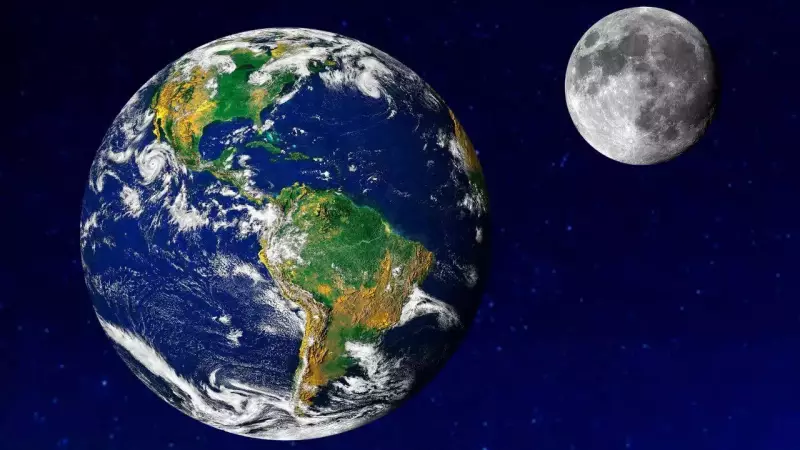
For billions of years, Earth's constant companion, the Moon, has governed our tides, stabilized our climate, and guided the evolution of life itself. Yet, this celestial partnership is slowly changing. Startling laser measurements confirm a silent retreat: the Moon is moving away from our planet at a rate of approximately 3.8 centimetres every year.
This gradual departure opens a fascinating window into the fundamental forces that govern planetary motion. While scientists have long pointed to tidal friction as the primary cause, emerging research suggests a more complex story is written in the cosmos, involving ancient planetary smash-ups and the very contraction of our world.
How Apollo's Mirrors Revealed a Moon on the Move
The first concrete evidence of this lunar escape came from a landmark human achievement. When the Apollo 11 astronauts placed a laser retroreflector on the Moon's surface in 1969, they gave humanity a permanent tool to measure its distance. By firing lasers from Earth and timing their return, scientists made a revolutionary discovery: our Moon is inching away year after year.

The classic explanation revolves around tidal friction. Earth's rapid rotation drags its ocean bulges slightly ahead of the Moon, creating a gravitational pull that transfers energy and gently pushes the satellite into a wider orbit. However, a study published in the Journal of Physical Science and Application argues that this tidal interaction is not the whole picture, introducing other powerful actors in this cosmic drama.
Ancient Collisions and a Shrinking Earth: The Hidden Forces
Rewind 4.5 billion years, to a time when the young Solar System was a violent shooting gallery of molten rock and debris. During this chaotic era, Earth was bombarded by prograde planetesimals—bodies orbiting in the same direction as our planet's spin. The new research proposes that these impacts subtly increased the Moon's tangential velocity. This boost enhanced its centrifugal force, allowing it to slowly overcome Earth's gravity and drift outward.
Furthermore, intense volcanic activity on early Earth may have hurled debris into orbit. As this material eventually coalesced with the Moon, it added to its mass and energy, creating a slow-motion 'snowball effect' that contributed to its migration.
The story also unfolds deep within our planet. As Earth's molten core cools and solidifies, its volume contracts. This process, while conserving angular momentum, reduces Earth's rotational inertia. The result? Our planet's spin rate accelerates slightly. This extra rotational energy is then transferred to the Moon's orbit, increasing its velocity and nudging it further away. Data from the National Institute of Standards of Technology supports measurable changes in Earth's rotational speed over time.
Implications for Earth and the Cosmic Dance of Other Worlds
The Moon's retreat is not just a celestial curiosity; it has profound, long-term consequences for Earth. As the distance grows, tidal forces will weaken, Earth's rotation will slow, and our days will become longer. These shifts can influence everything from ocean currents to the biological rhythms of life that evolved under the Moon's watch.
This revised understanding also helps explain phenomena on other worlds. Take Mars, for instance. Its moons, Phobos and Deimos, also exhibit orbital changes, yet Mars lacks significant oceans for tidal friction to be a major driver. Scientists now speculate that internal cooling and contraction, perhaps triggered by magma interacting with subsurface water, could be speeding up Mars's spin and pushing its moons away, mirroring the Earth-Moon system on a smaller scale.
Each year, as the Moon moves another 3.8 centimetres into the void, it carries with it a story billions of years in the making. It is a quiet testament to the dynamic and ever-changing nature of our universe, where even the most steadfast relationships are in a constant, graceful state of flux.






