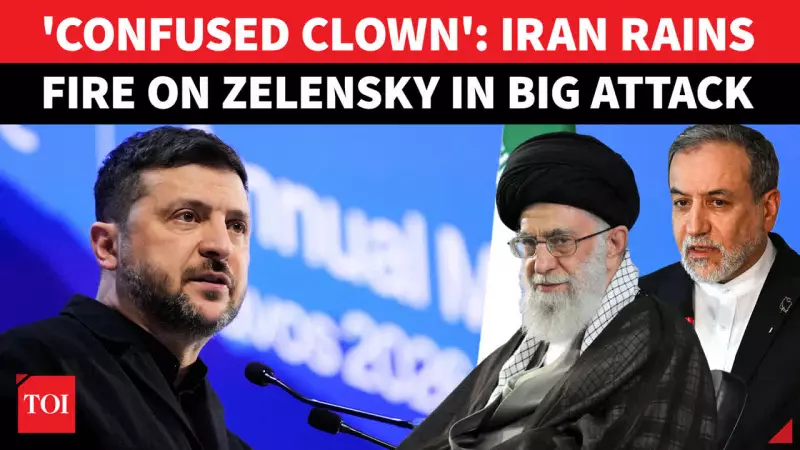
Iran's Foreign Minister Unleashes Scathing Verbal Attack on Ukrainian President Volodymyr Zelensky
In a dramatic escalation of diplomatic rhetoric, Iran's Foreign Minister Seyed Abbas Araghchi has launched a blistering verbal assault on Ukrainian President Volodymyr Zelensky, accusing him of multiple violations of international law and fundamental contradictions with the principles enshrined in the United Nations Charter.
Accusations of International Law Violations and UN Charter Contradictions
The Iranian diplomat's fiery remarks represent one of the most direct and personal attacks from Tehran against the Ukrainian leadership in recent memory. Araghchi specifically targeted Zelensky's foreign policy approach, characterizing it as fundamentally incompatible with established international legal frameworks.
"The Ukrainian leadership's actions represent a clear departure from the basic principles of international cooperation and mutual respect among sovereign nations," Araghchi stated in his condemnation, though he did not provide specific examples of the alleged violations beyond the broader accusations.

Condemnation of Western Military Support and Funding Requests
A central focus of Iran's criticism revolves around Kyiv's ongoing efforts to secure substantial Western financial assistance and military hardware. Araghchi characterized these efforts as destabilizing to regional and global security architectures, suggesting they undermine diplomatic solutions to ongoing conflicts.
The Iranian Foreign Minister was particularly pointed in his condemnation of Zelensky's recent calls for United States military action against Iran, which he labeled as "illegal and provocative" measures that violate the sovereignty of nations and established international protocols.
Escalating Rhetoric in Response to Zelensky's Previous Warnings
This diplomatic offensive from Tehran comes directly in response to President Zelensky's own recent warnings about Iran's political regime and its regional activities. The exchange represents a significant deterioration in diplomatic discourse between the two nations, with personal attacks now supplementing substantive policy disagreements.
The verbal confrontation signals:
- Widening geopolitical tensions extending beyond immediate regional conflicts
- A new level of personalization in diplomatic disputes between nations
- Increasing polarization in international responses to ongoing global security challenges
- Potential realignments in how nations position themselves regarding sovereignty and intervention principles
Analysts observing the exchange note that such direct personal attacks between foreign ministers and heads of state typically indicate particularly strained relations that may resist conventional diplomatic de-escalation efforts. The specific invocation of UN Charter principles suggests both sides are attempting to frame their positions within established international legal frameworks while accusing their counterparts of violating those same standards.
This diplomatic confrontation occurs against a backdrop of multiple intersecting global crises, with nations increasingly choosing sides in what appears to be a hardening of geopolitical blocs. The personal nature of the attacks suggests that what began as policy disagreements may be evolving into more fundamental clashes of political legitimacy and international standing.