

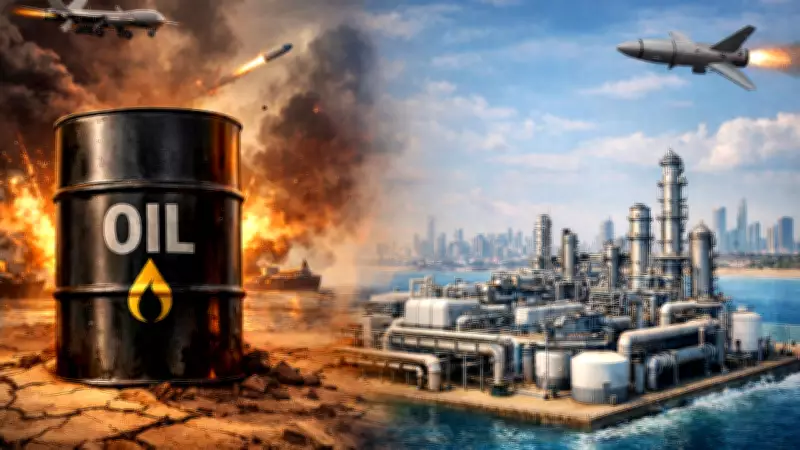
The Overlooked Vulnerability in the Iran Conflict
As the Iran war enters its critical phase, international media and governments remain fixated on the volatile oil markets. Analysts meticulously track tanker movements through the Strait of Hormuz, refinery shutdowns across the Gulf, and the alarming spike in global energy prices. Brent crude briefly surged past $120 per barrel as traders grappled with the potential disruption of nearly one-fifth of the world's oil supply. Governments worldwide are implementing emergency measures to cushion the economic shock, while investors scrutinize satellite imagery of ports and pipelines for any signs of escalating conflict.
The Silent Threat to Water Security
Amid this intense focus on petroleum, a far more immediate and devastating vulnerability has largely escaped global scrutiny: water security. Across the Arabian Gulf, some of the planet's wealthiest nations depend almost entirely on desalination plants that transform seawater into potable water. Metropolises like Dubai, Kuwait City, and Manama owe their very existence to extensive coastal facilities that pump and purify ocean water for millions of residents. Without these critical installations, taps would run dry within mere days, plunging urban centers into chaos.
The first casualties of this conflict have already brushed against Gulf waterworks. Iranian missiles and drones have struck shipping ports adjacent to major desalination complexes in the United Arab Emirates, causing disruptive power outages at these vital plants. On March 2, a barrage hit Dubai's Jebel Ali port, located just a dozen miles from the city's largest desalination site. Debris from a downed drone inflicted damage on the Fujairah F1 water-power facility and Kuwait's Doha West plant. Bahrain has publicly accused Tehran of a drone assault that "materially damaged" one of its desalination units, though authorities claim supplies remain stable for now.

Oil Market Turmoil and Global Repercussions
The Gulf region is responsible for approximately 20% of global oil production and nearly one-third of seaborne crude shipments. Even partial disruptions to shipping through the Strait of Hormuz trigger immediate price shocks worldwide. Global oil benchmarks have spiked by over 25% as markets brace for worst-case supply scenarios. While Saudi Arabia and the UAE have rushed to reassure international buyers, analysts warn of persistent supply constraints even if hostilities conclude rapidly.
Kuwait and Iraq have preemptively reduced output anticipating shipping delays, while Qatar suspended 20% of global liquefied natural gas exports following drone strikes. This energy shipment disruption is reverberating through global supply chains, reviving memories of the 1979 oil crisis and the protracted Iran-Iraq War. Investors are feverishly filling strategic reserves, while airlines and shipping companies hedge against skyrocketing Brent prices.
The Gulf's Thirst: Desalination as Lifeline
The Middle East's true strategic commodity isn't petroleum—it's water. Physically, the desert Gulf possesses almost no natural surface freshwater from rivers or lakes, making desalination an absolute necessity. During the 1970s, oil wealth financed massive reverse-osmosis and distillation plants. Today, approximately 450 desalination facilities line the Arabian Gulf coastline, converting saltwater into freshwater through energy-intensive electric pumps and heating systems.
Without this infrastructure, Gulf cities from Dubai to Manama would face collapse. The Central Intelligence Agency warned over a decade ago that losing just a few key plants could trigger "national crises" in nations like the UAE and Kuwait. Professor Michael Low of the University of Utah describes the Gulf as a "saltwater kingdom"—a monumental achievement of 20th-century engineering with a glaring Achilles' heel.

Natural rainfall in the region is nearly negligible, meaning "groundwater together with desalinated water account for about 90% of the region's main water resources." More than 400 plants along the Gulf coast provide the six Gulf Cooperation Council states with roughly 60% of global desalination capacity and nearly 40% of worldwide output. In the UAE, approximately 42% of urban water originates from the sea, while smaller states demonstrate even higher dependence: 90% of Kuwait's drinking water is desalinated, along with 86% for Oman and 70% for Saudi Arabia.
Desalination Under Direct Threat
The attack pattern is gradually evolving. During the conflict's initial week, most strikes targeted oil and gas infrastructure. United States and Israeli bombs reportedly hit Iranian nuclear sites and military bases, while Tehran launched missiles at Israeli territory and American installations in the region. Only recently have water targets emerged as casualties.
On March 7-8, an Iranian drone damaged Bahrain's primary desalination plant—the first Gulf nation to publicly report such an incident. Days earlier, Iran claimed a US strike on Qeshm Island's freshwater facility had cut off supplies to dozens of villages. On March 2, debris from an intercepted Iranian missile cratered the Dhofar desalination complex on Oman's coast. Even without direct hits, explosions at adjacent ports and pipelines can incapacitate desalination plants, many of which operate beside power stations vulnerable to grid attacks.
So far, no major Gulf desalination plant has been completely destroyed, but the risk remains starkly evident. Gulf countries maintain fewer backups for water than for oil. While Saudi Arabia can pipeline petroleum across the region, transferring water across borders presents formidable logistical challenges. Bahrain, Kuwait, and Qatar particularly lack natural freshwater lakes or mountain runoffs for emergency use.
Legal Protections and International Norms
Attacks on civilian water facilities are explicitly prohibited under international law. The Hague and Geneva Conventions protect objects indispensable to human survival. Article 54 of the First Additional Protocol to the Geneva Conventions states that warring parties "shall not attack, destroy, remove or render useless" drinking-water installations, supplies, and irrigation works. Deliberately targeting a city's water infrastructure can constitute a war crime or at minimum a grave breach of the laws of armed conflict.
In practice, however, modern conflicts have demonstrated a troubling erosion of this norm. Recent fighting in Gaza and Ukraine has seen power plants and water networks struck with impunity. Experts fear the Iran war could further undermine this critical taboo. Gulf legal specialists note that even if Iran's targets are claimed as military, any damage to neighboring countries' desalination plants would violate international conventions.
A Global Wake-Up Call
While the war's immediate repercussions center on Middle Eastern oil, the water issue carries profound global implications. Countries far from the Gulf are beginning to recognize the stakes. The World Health Organization has quietly urged enhanced water monitoring vigilance, while India's government watches closely given its reliance on Gulf crude and domestic water stress challenges.
The lesson from historical conflicts is unequivocal: weaponizing water invites humanitarian catastrophe. During the 1980s Iran-Iraq War, Iran's mining of the Gulf temporarily halved oil throughput, but Iraq's assault on Kuwait's water infrastructure proved far more devastating. Today, with desalination supporting tens of millions of lives, even minor damages could trigger emergency situations.
What Lies Ahead
Currently, Gulf desalination plants remain operational, and water continues flowing through pipelines that sustain some of Earth's most water-scarce cities. However, the events of recent weeks have exposed this system's profound fragility. Oil infrastructure can eventually be repaired, tankers rerouted, and markets stabilized. Water security offers dramatically less margin for error.
The Gulf's modern urban landscapes were constructed on the fundamental assumption that desalination would function reliably in the background—an invisible system transforming seawater into civilization. Warfare challenges this assumption directly. A single successful strike on a major plant could leave millions scrambling for emergency supplies within days, transforming a geopolitical conflict into a humanitarian crisis almost overnight.
This reality reveals why the greatest danger of the Iran war may not be the shock to global energy markets, but the erosion of an older, unwritten principle: that water must remain unequivocally off the battlefield.





