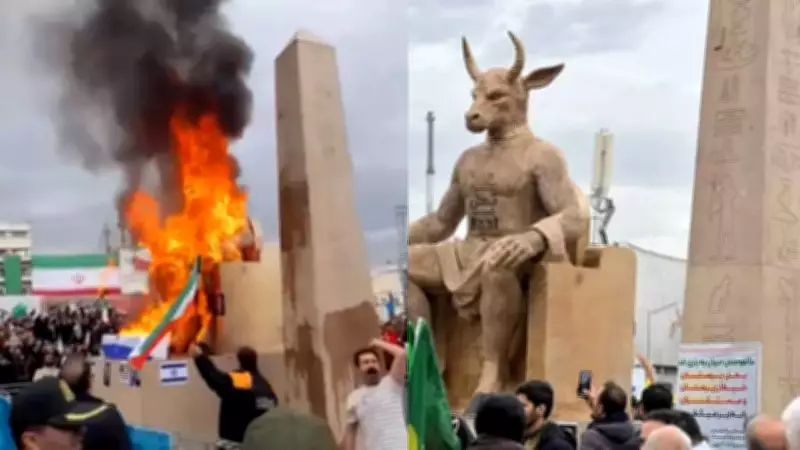
Iranian Protesters Burn Baal Effigy with Star of David at Revolution Anniversary Rally
At a state-organized rally in Iran commemorating the anniversary of the 1979 Islamic Revolution, demonstrators set fire to an effigy labeled "Baal" that featured horns and was prominently marked with the Star of David. The dramatic protest unfolded as chants of "Death to Israel" and "Death to America" reverberated through massive crowds, with images of the burning figure quickly spreading across various social media platforms.
Heightened Regional Tensions and Symbolic Displays
The demonstration occurred during a period of significantly heightened tensions between Iran, Israel, and the United States, following recent regional conflicts and renewed political friction. Iranian state media characterized the nationwide rallies as a powerful display of national unity against what they described as "imperial powers." Meanwhile, footage released by outlets affiliated with the Islamic Revolutionary Guard Corps showed additional effigies symbolizing both the United States and Israel being set ablaze during the events.
In Tehran, protesters displayed symbolic coffins bearing the names of senior United States military officials alongside missiles and wreckage from drones reportedly downed during previous confrontations. President Masoud Pezeshkian addressed the assembled crowds, calling for national unity in the face of what he characterized as foreign conspiracies against the Islamic Republic.

The Baal Effigy: Ancient Religious Imagery Meets Modern Politics
The burning of the Baal effigy stood out particularly for its sophisticated blending of ancient religious symbolism with contemporary political messaging. By inscribing the Star of David directly onto the figure, protesters appeared to deliberately equate Israel with concepts of corruption, evil, and satanic symbolism. Critics have warned that such provocative imagery risks inflaming existing religious hostilities and deepening sectarian divides in an already volatile region.
Historical Context: Who Was Baal?
Baal was an ancient Canaanite deity worshipped thousands of years ago throughout the Levant region. The name "Baal" translates to "lord" or "owner" in Semitic languages. According to Ugaritic texts discovered in modern-day Syria, Baal was described as a storm and fertility god closely associated with rain, agricultural prosperity, and divine power.
Archaeological discoveries from the ancient city of Ugarit depict Baal as a formidable warrior figure, typically shown wearing a distinctive horned helmet and wielding powerful weapons. He occupied a central position in Canaanite religious practice and was believed to reside on the sacred Mount Zaphon.
In the Hebrew Bible, Baal is portrayed as a direct rival to Yahweh and became a powerful symbol of idolatry. Over subsequent centuries, within both Jewish and Christian traditions, Baal and related figures such as Baal-Zebub (later rendered as Beelzebub) became increasingly associated with demonic imagery. This historical evolution contributed significantly to the broader perception of Baal as a false or evil deity within later religious narratives.
Modern Conspiracy Theories: Baal's Link to Jeffrey Epstein
In recent years, Baal's name has surfaced within various online conspiracy theories connected to disgraced financier Jeffrey Epstein. A document from the so-called "Epstein files" that circulated widely online appeared to show the term "baal.name" in a banking reference field. Some social media users interpreted this as potential evidence of occult symbolism or cult worship, with posts claiming Epstein had named a bank account after the ancient deity, thereby fueling narratives linking elite criminal activity with satanic imagery.
However, multiple fact-checking organizations have systematically disputed these claims. Independent analysts have suggested that "baal.name" was likely a garbled or misread version of "bank name" within a scanned document. No verified evidence has ever established that Jeffrey Epstein maintained any connection whatsoever to Baal worship or occult practices.

Epstein, who faced serious accusations of operating a sex trafficking network involving underage girls, died in federal custody in 2019 under controversial circumstances. His criminal activities and the numerous high-profile names associated with his case have fueled widespread speculation across digital platforms. For some observers, the association of elite abuse scandals with occult symbolism carries significant emotional resonance, even in the complete absence of factual proof.
Political Symbolism and Regional Implications
The strategic use of Baal imagery at the Iranian rally demonstrates how ancient mythological symbols continue to be deliberately repurposed within modern political conflicts. In this specific instance, the effigy appeared carefully designed to merge religious demonology with contemporary geopolitical rivalry, creating a potent visual statement against perceived adversaries.
While supporters may interpret such displays as legitimate expressions of resistance against foreign powers, numerous critics argue that blending religious symbolism with political anger dangerously risks deepening existing sectarian divides and complicating diplomatic resolutions. This episode powerfully underscores how history, faith, and politics remain tightly interwoven throughout the Middle East region, and how ancient figures like Baal can resurface in unexpected and controversial ways within present-day political discourse.