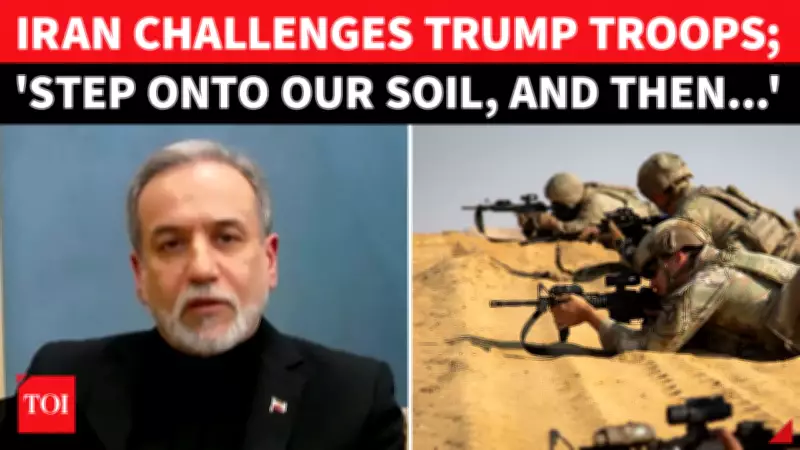
Iran's Foreign Minister Issues Defiant Warning to US President Trump Amid Escalating Conflict
In a bold and provocative statement, Iran's Foreign Minister Abbas Araghchi has directly challenged US President Donald Trump, daring him to launch a ground assault as fighting intensifies across the Middle East. This declaration comes amidst heightened regional tensions and follows recent joint military strikes by the United States and Israel targeting Iranian interests.
Denial of Ceasefire Talks and Rejection of US Interference
Araghchi firmly rejected reports suggesting that Tehran is engaged in backchannel negotiations with Washington to broker a ceasefire. He categorically dismissed these claims, emphasizing that Iran has no intention of discussing peace terms under current circumstances. His remarks were partly in response to President Trump's controversial suggestion that he should have a role in selecting Iran's next Supreme Leader, a statement Araghchi labeled as interference in Iran's internal affairs.
The Foreign Minister underscored that Iran's sovereignty is non-negotiable, and any external attempts to influence its leadership will be met with staunch resistance. This stance highlights the deep-seated animosity and lack of diplomatic trust between the two nations, which has only worsened with the recent escalation of hostilities.

Military Readiness and Warning of Retaliation
Araghchi went on to detail Iran's enhanced military preparedness in the wake of the US-Israel strikes. He asserted that Iran's armed forces have significantly bolstered their defensive and offensive capabilities, making them more resilient and ready for any future scenarios. "We are not just waiting for an attack; we are prepared to respond decisively," he warned, indicating that Tehran has contingency plans for various levels of escalation.
The Foreign Minister specifically addressed the possibility of a ground invasion, stating that Iran is fully equipped to counter such a move. His warning serves as a clear message to the US and its allies that any attempt to engage in large-scale ground operations will trigger a robust and immediate response from Iranian forces. This posture reflects Iran's strategy of deterrence, aiming to dissuade further military actions by projecting strength and resolve.
Escalating Tensions and Regional Implications
The conflict in the Middle East has seen a dramatic uptick in violence, with multiple fronts now active. Recent developments include:
- Joint airstrikes by US and Israeli forces targeting Iranian-backed militias and infrastructure.
- Increased missile and drone attacks from Iranian proxies against US bases and Israeli positions.
- A growing humanitarian crisis as civilian areas become caught in the crossfire.
Araghchi's comments signal Iran's unwavering commitment to its regional allies and its determination to resist what it perceives as Western aggression. This defiant stance is likely to further inflame tensions, potentially leading to more frequent and severe clashes. Analysts warn that the situation could spiral into a broader regional war if diplomatic efforts remain stalled.
Broader Context of US-Iran Relations
The current confrontation is rooted in years of geopolitical rivalry and ideological differences. Key factors contributing to the escalation include:
- The US withdrawal from the Iran nuclear deal and reimposition of sanctions.
- Iran's expanding influence in Syria, Iraq, and Yemen through proxy groups.
- Recurring incidents in the Persian Gulf, such as tanker seizures and naval confrontations.
President Trump's administration has maintained a policy of maximum pressure on Iran, aiming to curb its military ambitions and regional activities. In contrast, Iran has adopted a strategy of asymmetric warfare, leveraging its network of militias and missile capabilities to counter superior US firepower. Araghchi's latest remarks exemplify this approach, combining rhetorical defiance with assertions of military prowess.

As the conflict continues to escalate, the international community watches with concern. The risk of miscalculation or unintended escalation remains high, with potential consequences for global oil markets and regional stability. For now, Iran's message is clear: it stands ready to defend itself against any threat, including a ground invasion, and will not back down in the face of US pressure.