

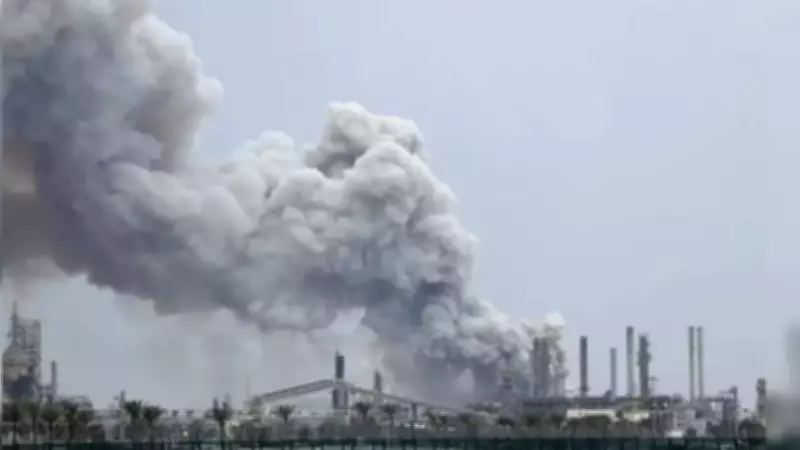
Iranian Drones Strike Kuwait's Key Oil Facility, Triggering Major Fires
In a significant escalation of regional hostilities, Iranian drones attacked Kuwait's crucial Mina al-Ahmadi oil refinery on Friday, according to the state-run Kuwait Petroleum Corporation. The strike ignited fires at the site, though fortunately, no injuries were reported. Firefighters were immediately deployed to control the blazes, marking another dangerous development in the targeting of critical energy infrastructure across the Gulf region.
Strategic Target and Production Implications
Mina al-Ahmadi represents one of Kuwait's three major refineries and has been repeatedly targeted during the ongoing conflict. These facilities are vital to Kuwait's oil production ecosystem, as any disruption can force oil wells to shut down due to a lack of processing capacity. Crucially, restarting refinery operations is a lengthy and complex process, meaning that production could remain affected long after the fires are extinguished, posing sustained economic challenges.
Wider Regional Escalation and Military Actions
This attack occurred amid a broader wave of Iranian aggression across the region, coinciding with ongoing hostilities involving the United States and Israel. Early on Friday, Iran launched assaults on multiple locations in the Gulf, with both Kuwait and Bahrain reporting incoming attacks, while Israel issued missile threat alerts. Simultaneously, the United States and Israel conducted airstrikes inside Iran, targeting areas around Tehran and Isfahan, though specific details of these targets remain unclear.

Despite assertions from Washington and Tel Aviv that Iran's military capabilities have been significantly degraded, Tehran has maintained persistent pressure on its regional adversaries. This sustained offensive underscores the volatile and escalating nature of the conflict.
Global Oil Market Disruptions and Price Surge
The targeting of energy infrastructure, combined with Iran's tightening control over the Strait of Hormuz, has severely disrupted global oil flows, driving prices sharply higher. Brent crude prices surged to approximately $109, reflecting an increase of over 50 percent since late February when the conflict intensified. The Strait of Hormuz remains a critical chokepoint, through which about one-fifth of the world's oil and gas supplies transit during peacetime, making any disruption a major concern for international markets.
United Nations Security Council and Diplomatic Efforts
In response to growing concerns, the United Nations Security Council is expected to vote on a proposal addressing security in the Strait of Hormuz, focusing on safe passage for commercial vessels. The proposal, initially put forward by Bahrain, included provisions allowing countries to "use all necessary means" to secure the waterway. However, permanent members such as Russia, China, and France have expressed opposition to authorizing the use of force.
French President Emmanuel Macron emphasized that a military solution would be impractical, warning that such an operation "would take an infinite amount of time and would expose anyone passing through the strait to coastal threats." He added that reopening the route "can only be done in coordination with Iran," pointing toward diplomacy following a potential ceasefire.
Mounting Casualties and Expanding Conflict Scope
The conflict, now entering its fifth week, has resulted in devastating casualties across multiple regions. Reports indicate over 1,900 people killed in Iran, with 19 deaths confirmed in Israel. Additional fatalities have been recorded in Gulf states, the occupied West Bank, and among US forces. In Lebanon, Israel's ground operations against Hezbollah have led to over 1,300 deaths and the displacement of more than one million people, with further casualties reported among Israeli troops.
The attack on Kuwait's refinery highlights the widening scope of the conflict, with energy infrastructure increasingly becoming a focal point in a war that continues to expand across the Middle East, threatening regional stability and global economic security.






