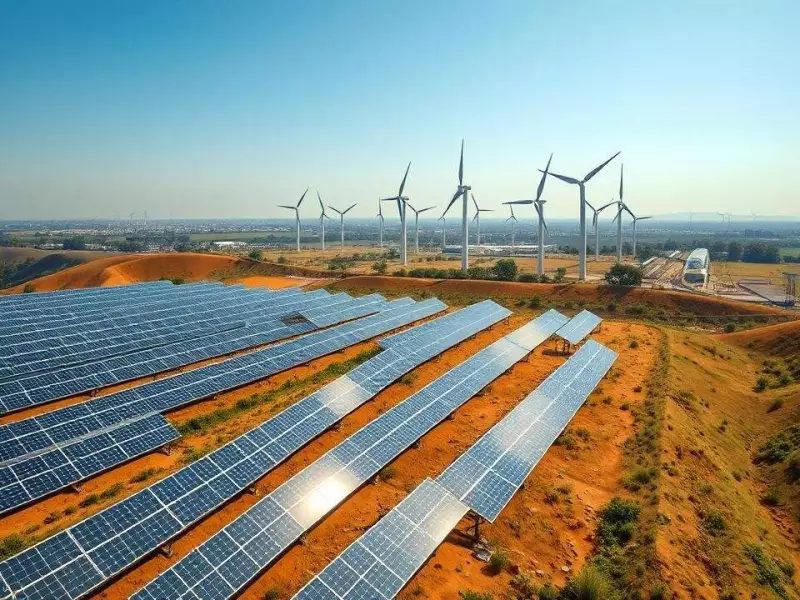
India's ambitious renewable energy transition requires robust long-term policy frameworks, accelerated technology adoption, and a strong push for domestic manufacturing to meet its climate commitments and power economic growth, according to leading industry experts. The call to action comes as the country achieves a significant installed power capacity milestone.
Policy Stability and Grid Modernization: National Priorities
Experts unanimously agree that clear and stable policy directions are fundamental for attracting sustained investment. Piyush Goyal, CEO and Co-founder of Volks Energie, emphasized that accelerating grid upgrades and storage adoption must be treated as national priorities. "India's future energy mix depends on both," he stated. Goyal also stressed the importance of incentivizing domestic production of critical components like inverters and batteries to reduce import reliance and build resilient supply chains.
Echoing this sentiment, Manish Dabkara, CMD of EKI Energy Services, pointed out that stable, long-term policy frameworks, especially for hybrid renewables, offshore wind, and green hydrogen, are crucial for drawing consistent private and global capital. He highlighted that emerging technologies such as green hydrogen and advanced storage systems have the potential to solve the challenges of intermittency and grid flexibility.

Current Challenges and the Road to FY2027
While progress is evident, operational hurdles remain. Ankit Jain of ICRA Ltd noted that although India's total installed power capacity has crossed a landmark figure, transmission infrastructure continues to be a critical bottleneck. He revealed that bidding activity slowed down, with only 8.6 GW auctioned in the first eight months of FY2026, partly due to delays in signing power purchase agreements.
Jain further warned that grid curtailments during peak renewable generation periods underscore the urgent need for storage solutions and grid strengthening. These measures are essential for maintaining grid stability and supporting the sector's growth momentum, making them key areas to monitor in the coming financial year FY2027.
Technology, Efficiency, and a Landmark Milestone
Gaurav Moda, Partner at EY-Parthenon India, observed that the focus is shifting from merely deploying technology to realizing measurable value. He stated that artificial intelligence (AI) is rapidly democratizing technology adoption across the energy value chain, with global companies already achieving significant efficiency gains and operational optimization through its use.
Amit Rautela, CFO of Meja Urja Nigam Private Ltd, provided concrete evidence of progress. He announced that as of September 30, 2025, India's total installed power capacity reached 500.89 GW. Within this, non-fossil fuel sources contribute 256.09 GW (51%), surpassing fossil fuels which stand at 244.80 GW (49%). This marks tangible advancement towards India's Net-Zero commitment. Rautela added that this scale-up, combined with historically low renewable tariffs, proves that the energy transition is now both cost-competitive and financially credible.
The consensus among energy leaders is clear: a multi-pronged strategy focusing on policy certainty, domestic manufacturing, grid modernization, and cutting-edge technology is indispensable for India to secure its energy future and meet its environmental goals.