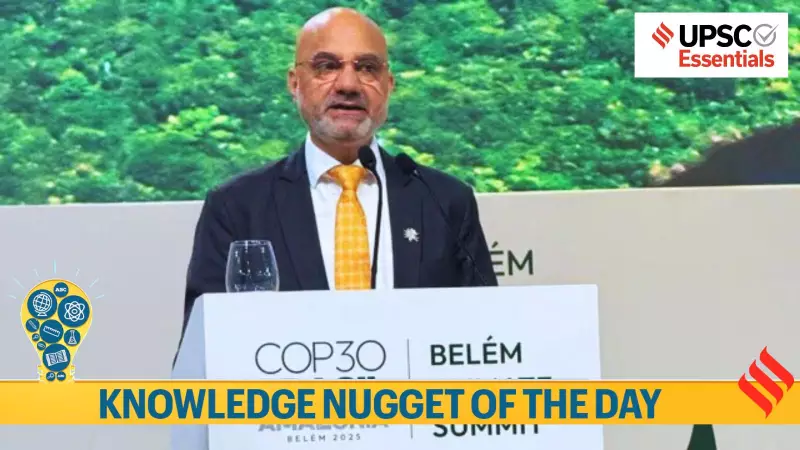
In a significant move for global forest conservation, India has officially joined the Brazil-led Tropical Forests Forever Facility (TFFF) as an observer. This development comes as the world marks the 10th anniversary of the Paris Agreement, with Indian Ambassador to Brazil Dinesh Bhatia reaffirming the country's commitment to multilateral climate action.
What is the Tropical Forests Forever Facility?
The TFFF represents a groundbreaking approach to forest conservation financing. Launched on November 6, 2025, this Brazil-led global fund aims to reward tropical nations for protecting and expanding their forest cover through performance-based payments rather than traditional grants.
The facility seeks to mobilize approximately $125 billion through both public and private investments. The generated returns will be used to compensate countries that successfully conserve and restore their tropical forests.

How TFFF Differs from Traditional Forest Finance
The TFFF stands apart from existing forest finance mechanisms in several crucial aspects. Unlike conventional donor-driven approaches, this initiative provides long-term, performance-based payments specifically for maintaining and increasing forest cover.
Traditional funding methods often focus on inputs rather than results and lack the flexibility to direct resources where they're most needed. The TFFF addresses this gap by creating a transparent, results-oriented system that rewards concrete conservation achievements.
Notably, the facility complements rather than replaces existing instruments like REDD+, generating new funding streams while ensuring financial sustainability through sovereign and institutional investments.
Operational Framework and Eligibility Criteria
The TFFF operates on principles of transparency and local autonomy. Tropical forest country governments and communities will determine the most effective conservation policies for their specific contexts, with payments directed to where they can achieve maximum impact.
Eligibility for the program requires meeting strict criteria: countries must maintain an annual deforestation rate below 0.5%, implement reliable monitoring systems, establish fair resource allocation mechanisms for Indigenous Peoples and Local Communities, and commit to transparency standards through the initiative's charter.
Important exclusions apply: high-income countries and regions with monoculture forests are not eligible for participation, ensuring the fund targets genuine tropical forest conservation.
India's Strategic Position and Global Implications
India's participation as an observer marks a significant diplomatic move. Ambassador Bhatia emphasized that India "welcomes and supports Brazil's initiative in establishing the Tropical Forests Forever Facility," describing it as "a significant step towards collective and sustained global action for the preservation of tropical forests."
While endorsing the facility, India also urged developed nations to accelerate their emission reduction targets and deliver on promised climate finance. The country stressed the importance of balancing mitigation efforts with adaptation measures, particularly for developing nations facing local climate vulnerabilities.
The TFFF could potentially support over 70 tropical forest countries encompassing more than 1 billion hectares of moist broadleaf tropical and subtropical forests, making it one of the most ambitious forest conservation initiatives to date.
Key Features That Make TFFF Unique
Several distinctive elements set the TFFF apart: As a Global South-led initiative, it represents a shift in climate finance governance. The facility ensures that at least 20% of payments reach Indigenous Peoples and Local Communities, recognizing their crucial role in forest stewardship.
Unlike carbon credit systems that can be volatile, the TFFF provides stable, long-term financing based on conservation outcomes. This approach values the ecosystem services provided by standing forests, addressing a critical market failure in environmental economics.

The facility's self-sustaining financial model, relying on investment returns rather than recurring donor contributions, offers a promising template for future conservation financing mechanisms worldwide.