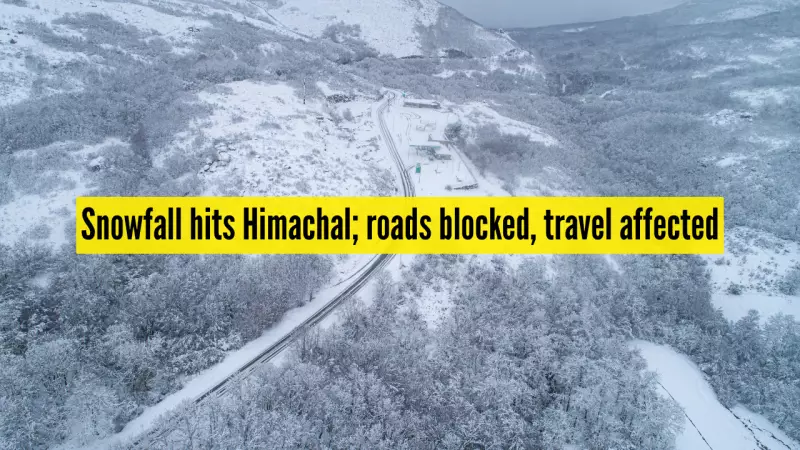
Severe snowfall accompanied by heavy rainfall brought daily life across Himachal Pradesh to a virtual standstill on Friday, creating widespread disruptions in transportation and power supply throughout the state. The sudden onset of harsh winter weather conditions severely hampered movement, plunged numerous areas into darkness, and compelled authorities to impose travel restrictions across affected regions.
Extensive Road Closures and Transportation Disruptions
According to reports from UNI, data released by the State Emergency Operation Centre (SEOC) revealed that a staggering 563 roads across Himachal Pradesh became impassable due to heavy snow accumulation. Major national highways, including NH-03 and NH-50, were not spared from the weather's impact, experiencing significant blockages that stranded travelers and disrupted essential supply chains.
District-Wise Impact Assessment
The tribal district of Lahul and Spiti bore the brunt of the severe weather, with approximately 290 roads closed in the area alone. This effectively isolated the district from neighboring regions, with critical routes such as the Koksar-Rohtang Pass, Darcha-Sarchu road, and Gramphu-Batal road completely shut down.

Chamba district reported 105 blocked roads, particularly affecting remote areas including Pangi, Tissa, Salooni, and Bharmour. Una district saw 70 roads closed, while Mandi experienced 64 road blockages. Other affected districts included Sirmaur with 20 closed roads, Kullu with nine, Kangra with four, and Solan with one. Notably, Bilaspur and Hamirpur remained the only two districts that escaped significant road closures.
In Shimla district, assessment efforts were hampered as the district emergency office itself lost electricity, preventing officials from completing a comprehensive evaluation of road conditions.
Widespread Power Infrastructure Damage
The severe weather caused substantial damage to power infrastructure across the state, with 4,797 distribution transformers rendered inoperative due to the extreme conditions. Solan district reported the highest number of affected transformers at 1,856, followed by Mandi with 901 disrupted transformers, Kullu with 682, Chamba with 659, and Sirmaur with 624. Lahaul and Spiti reported 53 affected transformers, while Una reported just two, according to SEOC data.
Extreme Weather Conditions and Temperature Plunge
Weather conditions in Shimla proved particularly severe, with the Shimla Meteorological Office reporting temperatures dropping well below normal seasonal levels. The state capital recorded a minimum temperature of 0°C and a maximum of just 0.6°C, significantly lower than the usual range of 3°C to 11°C. Shimla also received approximately 25 centimeters of snowfall throughout the day.
In Kullu district, fresh snowfall measuring nearly 45 centimeters (approximately one and a half feet) forced authorities to suspend vehicular movement on major thoroughfares. Nearby areas including Patlikuhal recorded around six centimeters of snow, while Banjar, Sainj, Anni, and Nirmand experienced substantial rainfall instead.
Specific Route Closures and Mobility Challenges
Traffic on the NH-03 stretch between Jhiri and Manali came to a complete halt after heavy snow accumulated near the 18 Mile point. The crucial Manali–Atal Tunnel Rohtang road was closed as a precautionary measure, while the Aut–Luhri section of NH-305 was shut down after snow buildup reached nearly three feet in certain stretches.
Local mobility in Kullu faced additional challenges when a fallen tree near Manikaran Gurudwara blocked the Bhuntar–Manikaran road (DMR-30). Although the Ramshila (Kullu)–Manali route via the left bank remained officially open, dangerous road conditions forced authorities to stop vehicles traveling to Manali at Patlikuhal.
Official Advisories and Restoration Efforts
Authorities have strongly urged both residents and tourists to avoid all non-essential travel and strictly adhere to official weather advisories. Officials confirmed that restoration work and road clearance operations would commence once weather conditions show significant improvement, prioritizing the reopening of critical transportation corridors and restoration of power supply to affected communities.