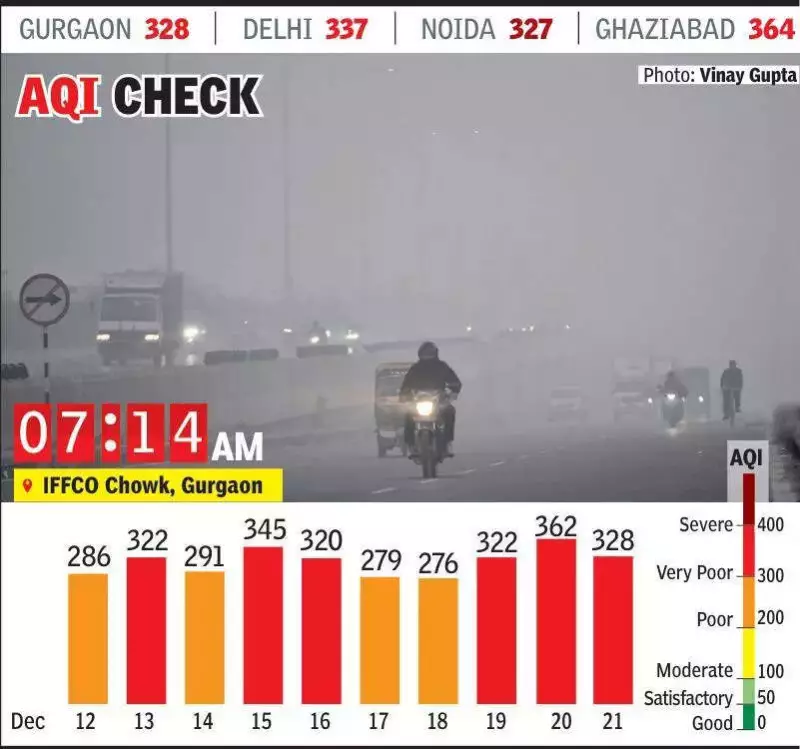
For the third day in a row, the air quality in Gurgaon has been classified as 'very poor,' posing a significant health hazard to its residents. On Sunday, the city's average Air Quality Index (AQI) was recorded at a concerning 328, as per official pollution monitoring data.
Consistently High Pollution Levels Throughout December
This marks a continuation of a grim trend. The AQI was 322 on December 19 and saw a sharp spike to 362 on December 20. An analysis of the month reveals that Gurgaon's air has largely oscillated between the 'poor' and 'very poor' categories. The AQI breached the 300-mark on multiple days this month, including December 6, 13, 15, 16, 19, and 20. Only brief respites were noted on December 9 and 18, when levels dipped to 260 and 276, respectively.
Station-level data paints a detailed picture of the crisis. On Sunday, Sector 51 recorded the worst air with an AQI of 345. It was followed by Teri Gram at 337 and Gwal Pahari at 314. All these readings fall squarely in the 'very poor' bracket. Data from the Vikas Sadan monitoring station was unavailable due to insufficient measurements.

Doctors Issue Stern Health Warning
Medical experts have raised alarms about the severe consequences of prolonged exposure to such polluted air. Dr. Kuldeep Kumar Grover, Head of Critical Care and Pulmonology at CK Birla Hospital, Gurgaon, explained the specific danger of PM2.5 particles. "Their extremely fine size allows them to penetrate deep into the lungs and even enter the bloodstream," he said. Once inside, they trigger inflammation and can cause damage to multiple organs.
Dr. Grover elaborated that long-term exposure elevates the risk of developing respiratory ailments like asthma, chronic bronchitis, and chronic obstructive pulmonary disease (COPD). It can lead to a decline in lung function, especially in vulnerable groups such as children, the elderly, and individuals with pre-existing conditions. Furthermore, PM2.5 compromises the lungs' natural defenses, making people more susceptible to recurrent infections, including pneumonia.
The health impact is not confined to the respiratory system. Once PM2.5 enters the bloodstream, it can adversely affect the cardiovascular system, increasing the risks of heart disease, strokes, hypertension, and irregular heart rhythms. Experts caution that these effects often develop insidiously and may only become apparent after repeated illnesses or persistent breathing difficulties.
Unfavourable Weather to Persist, Relief Unlikely Soon
Meteorological conditions are expected to remain unhelpful for dispersing the accumulated pollutants across the Delhi-NCR region. According to the Decision Support System (DSS) for air quality, December 21 is forecast to have a partly cloudy sky with mist or shallow fog in the evening and night. Winds will be light, blowing from the east to east-southeast at speeds up to 10 kmph. The predicted mixing depth is around 700 meters, with a low ventilation index of 500 m²/s, a combination deemed unfavourable for pollution dispersion.
The forecast for December 22 predicts moderate to dense fog in the morning. While winds are expected to shift to the west-northwest and increase to about 15 kmph by the afternoon, offering slight improvement, ventilation levels will likely stay low. Some marginal betterment in dispersion is anticipated on December 23 and 24 as wind speeds pick up further. However, air quality is predicted to remain in the 'very poor' category. The outlook for the subsequent six days ranges from 'very poor' to 'severe.'
In light of these conditions, officials have advised residents to limit outdoor activities, particularly during the early morning and late evening hours when fog and calm winds trap pollutants close to the ground. The air quality is expected to remain unstable over the coming days.