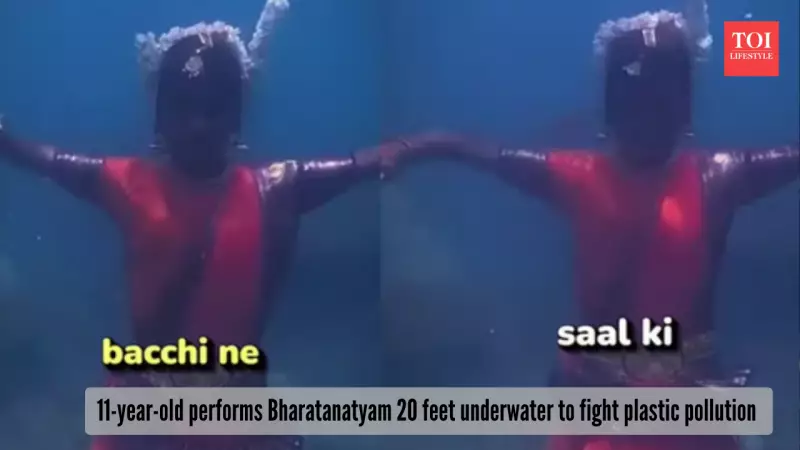
In an extraordinary act of environmental activism, an 11-year-old girl from Puducherry has captured the world's attention by merging classical Indian dance with a powerful message against plastic pollution. Thaaragai Aarathana performed a full Bharatanatyam routine 20 feet underwater, using the silent, graceful art form to highlight the crisis facing marine life.
A Silent Performance with a Loud Message
The performance, which took place in the ocean, featured Thaaragai dressed in complete traditional attire, including jewelry and makeup. Without any words or background music, she relied entirely on her expressions and precise mudras (hand gestures) to convey the distress of sea creatures trapped by plastic waste. The video of her act was shared on Instagram by ocean advocate Shubham Bhardwaj on December 23, 2025, under the title "The Girl Who Turned Dance Into an Ocean-Saving Mission." It quickly went viral, amassing over 24,000 views in just one day and hundreds of admiring comments.
Social Media Erupts in Praise
The online response was overwhelmingly positive and emotional. Instagram users hailed the young dancer's courage and creativity. One user commended her parents, writing, "Salute to her mother and father, who have such a big heart." Another focused on the performance's depth, stating, "Isko kahte hai respect and love for nature." A third viewer expressed awe at the physical challenge, noting, "That is beyond amazing! First of all, being able to go all the way deep is hard, yet alone hold your breath and dance is beyond words."

Bridging Tradition and Modern Activism
Thaaragai's act demonstrates how ancient art forms can be repurposed for contemporary causes. Bharatanatyam, traditionally used for devotion and storytelling, evolved here into a potent tool for environmental advocacy. By taking her dance beneath the waves, she created a stark visual metaphor, directly connecting cultural heritage with an urgent planetary issue.
The stunt underscores a devastating global problem. According to a 2023 UN Environment Programme (UNEP) report, approximately 11 million metric tonnes of plastic flow into the world's oceans annually. This pollution chokes coral reefs, endangers fish, and kills seabirds. Campaigns like Thaaragai's are vital in drawing public attention to this ecological emergency, proving that individual actions can inspire widespread awareness and demand for change.