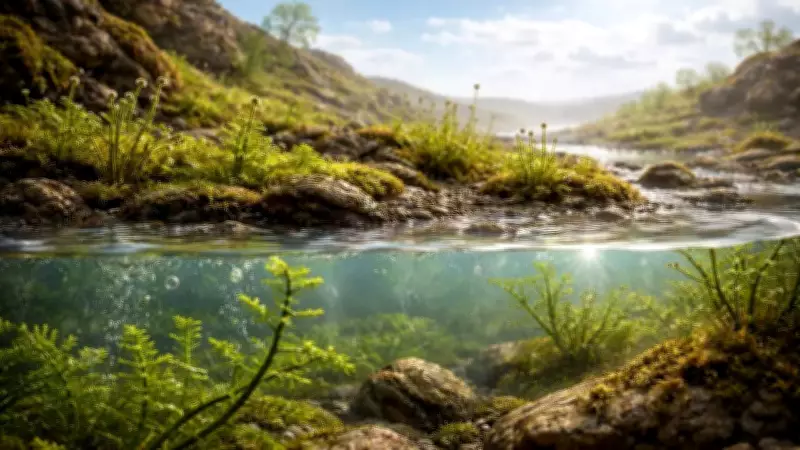
The Ancient Origins of Plant Life on Earth
The history of the first plant on Earth is not a simple tale of identifying a single species, but rather an epic evolutionary saga that began in the oceans and fundamentally reshaped our planet over billions of years. According to scientific consensus, the earliest ancestors of plants were not the towering trees or vibrant flowers we see today, but microscopic organisms that thrived in ancient seas.
The Oceanic Beginnings: Cyanobacteria and Green Algae
The earliest photosynthetic organisms, most likely cyanobacteria, are believed to have emerged between 2.7 to 3.0 billion years ago, based on extensive geological and fossil evidence. These primitive life forms played a pivotal role in gradually releasing oxygen into Earth's atmosphere through photosynthesis, culminating in the monumental Great Oxidation Event approximately 2.4 billion years ago.
Green algae, particularly freshwater varieties closely related to charophytes, are considered the direct ancestors of modern land plants. These aquatic organisms developed characteristics that would eventually define terrestrial plant life. Fossil evidence, including a groundbreaking study published in Science, reveals approximately 470–480 million-year-old fossil spores that represent the critical transition from aquatic algae to early land plant ancestors.

The Great Leap: From Water to Land
The aquatic environment provided stability and nourishment for early algae, but at some crucial point in evolutionary history, certain algae began adapting to life outside water. This transition marks one of the most significant moments in Earth's biological history—the advent of plants on land.
The first true land plants appeared around 470 million years ago during the Ordovician period. These ancient plants bore little resemblance to modern flora, being small, simple organisms that lacked roots, stems, or leaves. Scientists believe they resembled contemporary bryophytes like mosses and liverworts, though their exact form remains uncertain. These primitive plants grew close to the ground and required constant moisture due to their underdeveloped water transport systems.
These pioneering organisms faced tremendous challenges including desiccation and intense solar radiation, yet they not only survived but began colonizing terrestrial environments, setting the stage for all future land-based life.
How Early Plants Transformed Our Planet
The emergence of plants on land had profound and lasting effects on Earth's systems. Before their arrival, terrestrial environments were largely barren of complex life, though microbial organisms may have existed on land surfaces.
Plants revolutionized Earth in several key ways:
- They began breaking down rocks through physical and chemical processes
- They dramatically altered atmospheric composition through photosynthesis, absorbing carbon dioxide and releasing oxygen
- They formed symbiotic relationships with fungi that helped them absorb nutrients from soil—a crucial adaptation given their lack of developed root systems
The Evolution of Complexity: From Simple to Sophisticated
Following the establishment of these first land plants, evolution gradually produced more complex forms. Vascular plants, which developed specialized tissues for transporting water and nutrients, emerged later in the fossil record. This evolutionary advancement allowed plants to grow taller and spread across greater distances.
Early vascular plants like Cooksonia, which displayed primitive branching patterns, represent significant milestones in plant evolution. Some molecular studies suggest that land plant ancestors may have begun evolving as early as 600–700 million years ago, though definitive fossil evidence appears much later in the geological record.
Why Defining the "First Plant" Remains Challenging
The concept of a singular "first plant" is scientifically problematic because evolution occurs gradually over immense timescales. There was no sudden appearance of the first plant; rather, there was a slow, continuous transition from photosynthetic aquatic life to algae and eventually to land plants.

Scientists continue to study fossils, genetics, and ancient environments to unravel the complexities of plant evolution. Recent discoveries indicate that plant evolution on land may have begun as far back as 700 million years ago, suggesting an even longer and more gradual process than previously understood.
A Slow Beginning with Monumental Consequences
Though the first plants were small and simple, their impact on Earth has been nothing short of revolutionary. They transformed barren landscapes into thriving ecosystems, created conditions that allowed animal life to evolve, and produced the oxygen-rich atmosphere that sustains life today.
The story of plant origins is significant not only for its historical importance but also as a testament to life's remarkable ability to adapt, survive, and fundamentally alter planetary systems. This evolutionary journey from microscopic ocean algae to land-colonizing pioneers represents one of the most transformative chapters in Earth's biological history.