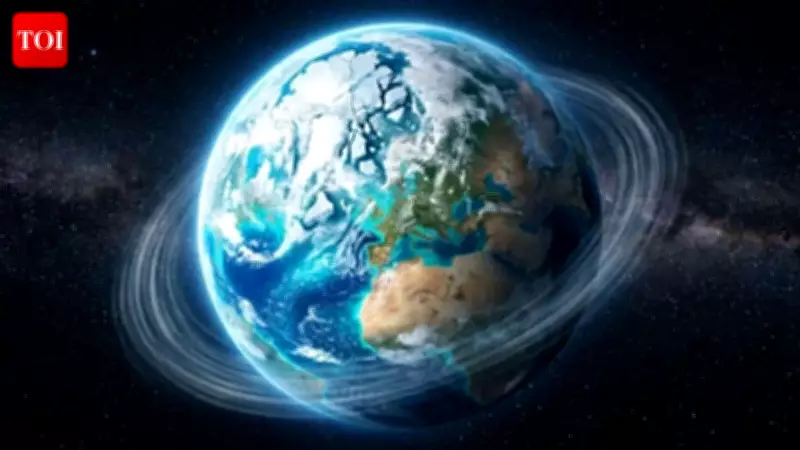
Imagine waking up to discover that the day has 25 hours instead of the usual 24. Clocks would shift, work schedules would roll forward, and everything from sleep to business would have to adjust. This scenario sounds like science fiction, but recent chatter has claimed that Earth's rotation is slowing down and that 25-hour days are imminent. However, what is actually happening?
The buzz originates from a recent study suggesting that human-driven climate change is decelerating Earth's spin faster than at any point in the last 3.6 million years. This news has stirred confusion and curiosity. Are we about to break free from the 24-hour day? Is climate change truly disrupting the planet's rotation? Will we notice any changes soon?
Yes, Earth's rotation is indeed slowing, but there is no need to prepare for longer days just yet. The change is minuscule, measured in milliseconds, not hours. Those hopeful thoughts about a 25-hour day are far from reality; we would have to wait hundreds of millions of years before Earth gains even one extra hour in its daily rotation.

What Did Scientists Actually Discover?
In a new study published in the Journal of Geophysical Research: Solid Earth, researchers from the University of Vienna and ETH Zurich determined that the current rate of day lengthening is unprecedented in the past 3.6 million years. Melting glaciers and ice sheets are causing sea levels to rise, redistributing Earth's mass, and consequently slowing the planet's spin.
The science behind this is straightforward. As polar ice melts, water flows into the oceans and shifts toward the equator. This redistribution of mass slows Earth, similar to a spinning figure skater who extends their arms and rotates more slowly. The study indicates that day length is currently increasing by approximately 1.33 milliseconds per century due to climate-related sea-level rise. If greenhouse gas emissions remain high, this rate could reach up to 2.62 milliseconds per century by 2080. According to the study, Mostafa Kiani Shahvandi from the University of Vienna and Benedikt Soja from ETH Zurich emphasize that this rapid increase in day length is unparalleled over the last 3.6 million years.
Is Earth slowing down? Yes, it is, but you will never notice it.
Why Is This Happening?
Earth's rotation is not constant; it speeds up and slows down for various reasons, including shifts in the molten core, atmospheric changes, ocean currents, earthquakes, and the gravitational pull of the Moon. Recently, there have been record-short days due to natural fluctuations, but the long-term trend is gradual slowing. The Moon's gravity is the primary driver over vast timescales, creating tides and gradually extracting rotational energy from Earth through friction. This process has been lengthening days for billions of years.
Will Days Become 25 Hours Long?
In theory, yes, it seems plausible, but practically, it is extremely unlikely. Earth's rotation is slowing by about 1.8 to 2 milliseconds per century due to tidal effects. At this rate, it would take approximately 200 million years for a day to become one hour longer. Therefore, viral claims about an imminent 25-hour day are far from accurate. While the trend is real, the timescales involved are so immense that no one alive today, nor for thousands of generations, will experience a 25-hour day. With the current climate-driven pace, a day lengthens by only 0.00133 seconds over a century.
Why Do Scientists Care About Millisecond Changes?
Modern technology relies on extremely precise timing. Satellite navigation, GPS, telecommunications networks, financial trading, and space missions all depend on accurate timekeeping. Slight variations in Earth's rotation require scientists to adjust clocks to maintain synchronization. Although most people do not think about aligning atomic clocks with Earth's actual spin, it is crucial for global systems.

The Truth Behind the Viral Story
This phenomenon underscores the far-reaching impact of climate change. Rather than preparing for a longer workday, the striking aspect is that climate change is influencing something as fundamental as Earth's rotation. Human activities warm the atmosphere, melt glaciers, and raise sea levels, and this mass redistribution subtly alters the planet's spin. It is another reminder that everything on Earth is interconnected. Our actions can change not just the weather but even time itself. While day length is not stretching by hours anytime soon, the planet's rhythm is now being affected by human influence.
In truth, the 24-hour day is not going anywhere. However, climate change is proving powerful enough to alter the very spin of our world, one millisecond at a time.