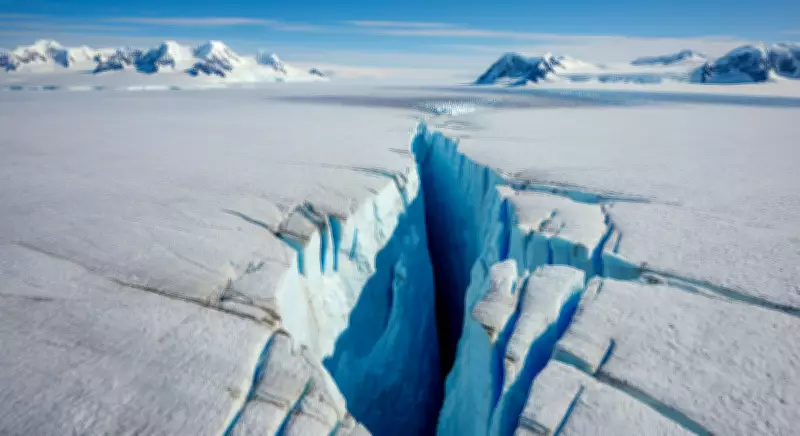
It is safe to say that when we think about the deepest spots on Earth, we normally imagine the scorching valleys of the Middle East or the striking, dust-filled depressions in the Western United States. These are places where you can see the depth with your own eyes. However, the deepest point on Earth is not so easily observed.
The Lowest Natural Point on Earth
The answer to what the lowest natural point on Earth is, is not an exposed ravine or a sunken depression in a desert, but rather an enormous ice-filled trench buried under the icy surface of East Antarctica. It remained hidden from human knowledge for many years because it is locked away under the tremendous mass of ice called the Denman Glacier. This is a place where the ground descends deep enough to be lower than sea level.
Exploring an Underground Canyon Buried Under Miles of Ice
Finding such an underground canyon required state-of-the-art technology capable of exploring under kilometers of ice. Initially, conventional radar mapping could not provide accurate depth measurements due to the canyon's extremely steep sides, which caused the radar to reflect off the walls prematurely.

According to a landmark study published in the journal Nature Geoscience, the breakthrough came when scientists combined radar data with a technique called mass conservation. By calculating how much ice was flowing through the region and at what speed, they could mathematically determine the exact shape and depth of the bed underneath.
The findings were astonishing. The Denman trough descends to a depth of more than 3,500 meters (11,500 feet) below the ocean surface. In other words, the lowest point of this subterranean trench lies as deep as the typical depth of the world's oceans. The sheer vertical descent of this hidden structure far exceeds almost all visible landforms on Earth, but it is totally packed with slowly flowing ice.
Why Does the Shape of the Bed Matter?
The mind-blowing depth of the trough is an interesting statistic, but the most important finding is its real-world impact. The shape of the ground underlying Antarctica influences how glaciers behave and respond to climate change. For example, if the bed under a glacier inclines inward to a deep trench, it creates a route for the intrusion of warm seawater, which may significantly accelerate the melting process.
A report shared by the NASA Earth Observatory titled Denman Glacier Losing Some of Its Footing explains that this hidden architecture is a key factor in predicting the future of global sea levels. In some areas, hidden ridges under the ice act like speed bumps, pinning the glacier in place and keeping it stable. However, deep troughs like the one found under Denman can act as slippery slides. Understanding where these deep points are located allows scientists to identify which parts of the continent are most vulnerable to destabilization.
Implications for the Planet
It means that the lowest land elevation on Earth is no mere geological oddity. This feature is an important component of the planet's hydrologic cycle, one which directly affects the well-being of our oceans. As we further our knowledge of this "frozen map," we discover that beneath the icy blanket of Antarctica lies a dramatic terrain as challenging as anything seen on the surface.
This discovery serves to illustrate that there are areas on our planet that remain unknown to us, but we are just starting to learn about them. Some of the most inhospitable features found in nature may not be lying exposed in the open air but may be hidden in the silent recesses of the polar ice caps.