Dutch Floating Homes: A Global Blueprint for Climate Adaptation and Housing
For centuries, the Netherlands has existed in a delicate balance with water. A significant portion of the nation lies below sea level, with rivers, canals, and coastlines fundamentally shaping daily life. The Dutch have historically relied on an extensive network of dikes, dams, and drainage systems to protect their land. However, in recent years, this challenge has intensified dramatically due to rising sea levels, increased rainfall, and more frequent flooding events.
Compounding this environmental pressure is a severe national housing shortage. Millions of citizens are searching for affordable homes, yet available land is extremely scarce. In response, many Dutch communities are shifting their strategy from fighting water to living harmoniously with it. Floating homes, once considered unconventional, are now emerging as a key component of modern urban planning.
Why Floating Homes in the Netherlands Are Gaining Global Attention
The Netherlands ranks among the world's most flood-prone countries. Storm surges, heavy precipitation, and sea level rise collectively elevate the risk of substantial damage. Climate scientists consistently warn that these threats will escalate in the coming decades.

Simultaneously, the country faces an urgent need for new housing. Officials estimate that approximately one million new homes will be required over the next ten years. Suitable land, however, is limited, with many areas already densely developed or protected for agricultural and natural purposes.
Floating homes present a innovative solution by utilizing water space instead of land. Canals, lakes, and harbors can be transformed into residential areas without sacrificing valuable farmland or green zones. This represents a profound philosophical shift: where water was once viewed primarily as a danger to be excluded, contemporary city planners are increasingly adopting a collaborative approach, working with water rather than against it.
Engineering Innovation: How Dutch Floating Homes Are Constructed
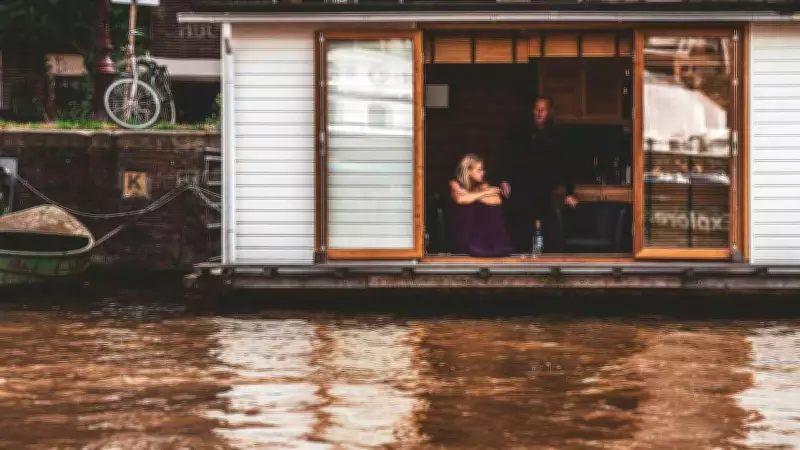
Dutch floating homes are distinct from traditional houseboats. They are permanent structures constructed with modern materials, typically built on concrete platforms that serve as floating foundations. These platforms are secured to steel poles driven into the waterbed, allowing the houses to move vertically while remaining anchored in place. This system ensures stability during storms and fluctuating water levels.
The buildings are fully integrated with municipal utilities, including electricity, water, sewage, and internet networks. Internally, they closely resemble conventional land-based houses. A concrete hull beneath each home acts as a counterweight, maintaining balance and minimizing movement even in adverse weather conditions.
Residents like Siti Boelen report feeling safer during storms because their homes float with the water rather than resisting its pressure. This sense of security is a significant factor driving growing interest in water-based housing.
Schoonschip: A Pioneering Floating Community in Amsterdam
One of the most renowned floating neighborhoods is Schoonschip in Amsterdam. Initiated in 2009 by Dutch television director Marjan de Blok, the project aimed to create a sustainable community on water. After extensive planning and collaboration with authorities, Schoonschip now comprises 30 floating homes, including duplexes, located in a repurposed industrial canal area.
The community emphasizes shared sustainability systems. Residents operate joint heat pumps for heating and cooling, while solar panels cover approximately one-third of each roof, with energy shared collectively. Rainwater collection, advanced waste management, and electric transport further reduce environmental impact and operational costs. Schoonschip exemplifies how floating housing can effectively merge climate adaptation with sustainable living principles.

Governmental Support and Policy Evolution
Amsterdam city officials are actively revising planning laws to facilitate more floating projects. City councillor Nienke van Renssen from the GreenLeft party emphasizes that floating homes enable multifunctional space use and align with long-term sustainability objectives. By updating zoning regulations, the city aims to streamline the process for developers and residents interested in building on water.
Rotterdam, another major Dutch city largely situated below sea level, has incorporated floating structures into its Climate Proof and Adaptation Strategy since 2010. The city now hosts Europe's largest floating office building and a floating dairy farm. Arnoud Molenaar, Rotterdam's chief resilience officer, notes that the city now perceives water as an opportunity rather than solely a threat.
From Local Innovation to Global Climate Solution
Dutch expertise in floating architecture is now being applied internationally. Firms like Waterstudio, led by Koen Olthuis, have designed around 300 floating structures worldwide. A major project in the Maldives aims to create a floating district capable of housing approximately 20,000 people, addressing the severe risks posed by rising sea levels to island nations.
Another company, Blue21, is developing plans for floating islands in the Baltic Sea designed for up to 50,000 residents. Olthuis observes that floating homes are no longer viewed as eccentric experiments but are becoming integral to what he terms "blue cities," where water is utilized as a fundamental planning tool. This approach is influencing coastal development in regions such as French Polynesia and Southeast Asia.
Challenges and Considerations of Aquatic Living
Floating homes are not without difficulties. Strong storms can cause noticeable movement, and specialized infrastructure for utilities, waste systems, and emergency access requires meticulous design. Maintenance costs often exceed those for land-based housing, and large-scale development demands significant investment in materials, technology, and engineering expertise.
Rutger de Graaf of Blue21 highlights the urgency of scaling up, noting that hundreds of millions of people may be displaced by rising seas later this century. Achieving this scale, however, will require substantial time and political commitment.
Addressing the Housing Crisis Through Innovation
While floating housing alone cannot resolve the Netherlands' need for one million new homes, it provides valuable additional capacity. By utilizing water space, cities can expand without encroaching on green areas. For low-lying countries and island states, where land is literally disappearing, building on water may become one of the few viable options.
Dutch-led projects are already informing urban planning in vulnerable regions worldwide, demonstrating the potential of this model.
A Model for Climate-Resilient Living
Floating homes in the Netherlands represent more than a housing trend; they signify a fundamental shift in societal response to environmental change. Instead of attempting to dominate nature, these communities adapt to it, with homes designed to rise with floods and neighborhoods built for flexibility. Shared energy and water systems enhance sustainability and community cohesion.
From Amsterdam's canals to ambitious projects in the Maldives, this model is gaining global traction. It combines advanced engineering, environmental stewardship, and social cooperation. As climate risks intensify and land becomes increasingly scarce, living on water may transition from an exception to a necessity. The Dutch experience illustrates how innovation, strategic planning, and long-term vision can transform a natural threat into a viable habitat for the future.