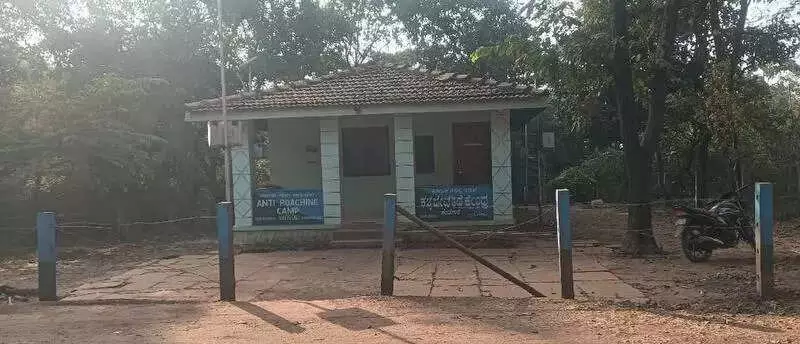
Serious concerns over wildlife safety have emerged in the forests of Belagavi district, where more than 15 anti-poaching camps have remained non-functional for nearly three years. This prolonged inactivity has reportedly given poachers and illegal operators a free hand in several vulnerable forest stretches across Khanapur, Londa, Nagaragali, and Kanakumbi ranges.
Camp Closures Leave Forests Unprotected
The camps, which were established as critical outposts for forest protection, have been largely defunct since their contract-based watchers were discontinued about three years ago. Sources indicate that each camp previously employed four watchers who worked in shifts to monitor both vehicle and human movement deep within the forest areas. The discontinuation was due to financial constraints, leaving permanent structures and basic facilities at these locations unused and abandoned.
Among the latest casualties is the Shedegali anti-poaching camp in the Khanapur forest range, which ceased operations just two months ago. This camp held particular significance due to its location on the Khanapur–Hemmadaga Road, a key route connecting Karnataka and Goa. It enforced a crucial night-time restriction on vehicle movement between 7 PM and 7 AM. With its closure, vehicular movement along this forest stretch now continues unchecked throughout the night.

Critical Gaps in Key Territorial Ranges
While anti-poaching camps within the protected area of the Bhimgad Wildlife Sanctuary are largely operational, the failure of camps in critical territorial forest ranges has become a major issue. Wildlife conservationist Giridhar Kulkarni provided a list of defunct camps, which includes vital outposts like:
- Daroli, Chapoli, and Shedegali in the Khanapur range
- Diggegali and Rajawal in the Londa range
- Chorla in the Kanakumbi range
- Several camps in the Nagaragali range
Kulkarni emphasized that many of these camps are situated in ecologically important habitats and along inter-state borders, making their operational status vital for effective wildlife protection and law enforcement. He stressed the urgent need for immediate financial allocation to revive these camps to strengthen anti-poaching measures and ensure long-term conservation in the region.
Official Response and Persistent Concerns
When contacted, the district conservator of forests (DCF), NE Kranti, confirmed that the contract-based watchers were indeed discontinued three years ago. However, he maintained that several of the camps continue to function, even as he acknowledged persistent concerns over protection gaps in key forest areas.
The prolonged non-operation of these camps has effectively crippled a frontline system designed to regulate unauthorized entry and prevent poaching and other illegal activities like timber smuggling. Environmentalists warn that the situation demands immediate intervention from the forest department and state government to plug these security holes and safeguard the region's rich biodiversity.