In the deep parts of the South Atlantic Ocean, researchers have uncovered a surprising geological feature embedded in fractured and broken volcanic rocks located below the seafloor. Far from looking like common debris, the rocks appear to hide geological sponges able to store vast quantities of carbon dioxide over millions of years.
Breakthrough in Ocean Carbon Storage
This breakthrough is highlighted by scientists analysing samples collected from drill cores taken from the South Atlantic. They revealed that talus breccias, a name given to fractured layers of volcanic rocks, contained an excess of carbon dioxide absorbed from seawater, in contrast to earlier studies conducted in the upper ocean crust.
This discovery implies that Earth’s oceans might be storing much more carbon dioxide than expected by previous calculations. According to researchers, the process could contribute significantly more to the Earth’s carbon cycle than initially thought.

Scientists’ Discovery Beneath the Seafloor
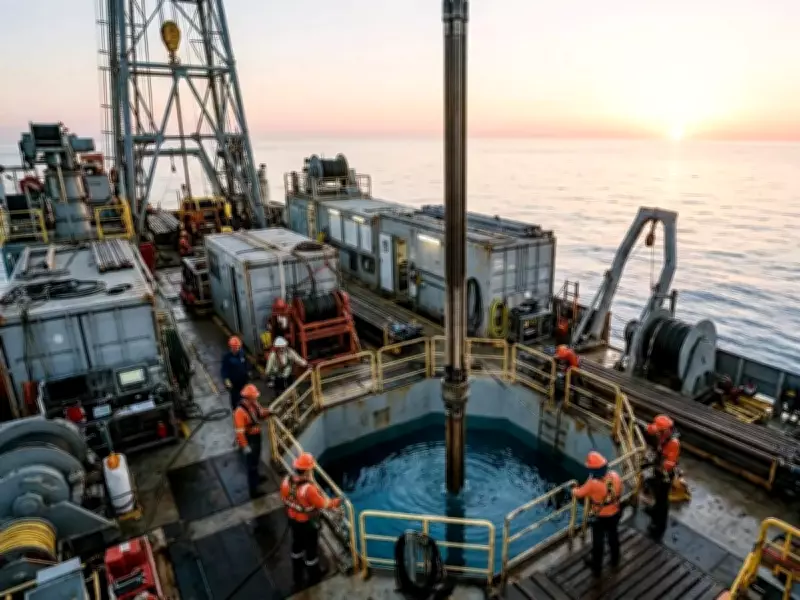
For the study published in Nature Geoscience, researchers investigated rock cores sampled through International Ocean Discovery Program Expeditions 390 and 393 in the South Atlantic region. The cores were obtained from ridge-flank sites where the ancient ocean crust had fractured and broken down.
High carbon concentration was discovered within the recovered cores in the form of carbonate mineral deposits. In particular, the paper reports that talus breccias had about 7.5 weight percent of carbon dioxide derived from seawater. The values are twice as high as for earlier studies of upper ocean crust samples and can be from 2 to 40 times higher.
According to scientists, the role of the rock debris was to serve as a filter through which seawater circulated. During such filtration, carbon was deposited within newly developed minerals due to chemical reactions. Moreover, according to the study, even thin layers of such rubble might compete with adjacent ocean crust in carbon capacity.
How Broken Rocks Contain More Carbon
What makes the study interesting is the fact that broken rocks have been identified as better carbon sinks than solid lava flows. First, talus breccia has high porosity and a fractured structure, which means that there is an increased number of pathways for seawater circulation. During the process, seawater reacts with basalt, depositing carbonates.
Thus, in general, the fractured volcanic rubble has a similar function to that of a sponge. The researchers noted in their study that the fluid-rock interactions are key to carbon storage within oceanic crust.
Heavier lava flows have fewer passages through which seawater can pass. Therefore, they become less reactive over time. On the other hand, fragmented basalt provides more surface for seawater, thus giving it more chances to react and trap carbon.
How the Breakthrough Could Affect the Global Carbon Cycle
Researchers were aware that transformed oceanic crust played a crucial role in the deep carbon cycle on Earth. According to a study published in PNAS, altered oceanic crust annually transfers 18 million tons of carbon into subduction zones.
The new study reveals that there might be an underestimation of the amount of carbon stored in the ocean floor worldwide. However, it is vital to note that the seafloor would not resolve climate change independently. This phenomenon occurs at an extraordinarily slow pace over millions of years. Yet, the researchers claim that studying the unknown carbon reserves is essential because even minor adjustments in global carbon accounting can affect future climate predictions.
This finding is another illustration of how geological processes often go unnoticed. Researchers commented that sometimes the biggest surprise isn’t a new location but a new understanding of a well-known process.
Hidden Carbon Sinks Could Be Much Bigger on Slow-Spreading Ridges
Also important was the kind of seafloor where the discovery occurred. The researchers studied slow-spreading ridges, characterised by the slower spreading of the plates. Slow-spreading seafloors produce more rugged and faulted rock formations than smooth seafloors. As a result, talus breccia is formed in greater amounts.

According to scientists, such environments provide excellent conditions for long-term seawater circulation and carbonate precipitation. This means that slow-spreading ridges could be more efficient long-term carbon sinks than smooth areas of the ocean floor.
Now, researchers aim to find out whether there are similar rubble-filled regions within other global seafloor ridge systems. Such findings would suggest the presence of even more substantial carbon storage capacity of Earth’s oceanic crust than previously recognised.
A Subtle Mechanism That Scientists Might Have Overlooked
Samples taken from the Southern Atlantic Ocean are altering how scientists perceive the ocean floor. What was once believed to be mere remnants of volcanic eruptions is now being viewed as a dynamic component in the carbon sink system of the Earth.
This finding doesn’t alter climate science by any means, but it does provide a valuable insight into a crucial component of the global carbon cycle. It also reveals that some of the essential activities on Earth, especially those related to climate change, can occur slowly and silently under the sea floor. It appears as though the deep carbon cycle is becoming increasingly complicated for the scientists studying it.