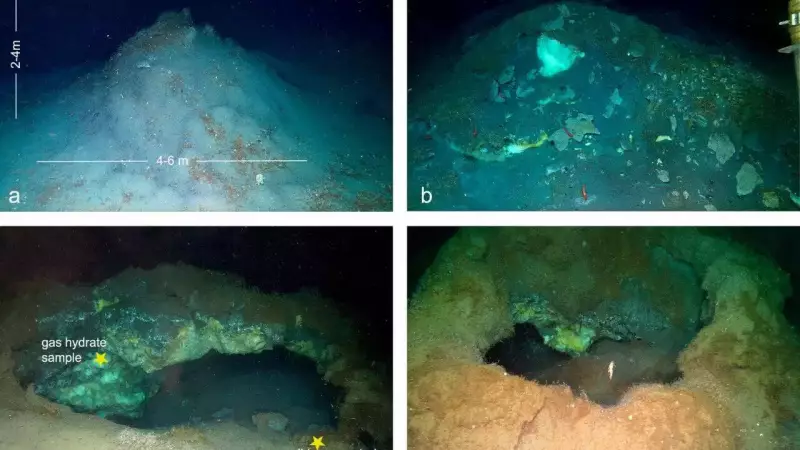
In a groundbreaking discovery that pushes the boundaries of Arctic exploration, an international team of scientists has uncovered a vast, previously unknown geological and biological complex deep beneath the icy waters of the Greenland Sea. This remarkable find, located in one of Earth's most remote and extreme environments, is set to significantly expand our understanding of oceanography, deep-sea ecosystems, and climate processes at the planet's poles.
Methane Hydrate Mounds on the Deep Ocean Floor
The most striking feature of the discovery is a series of gas hydrate mounds situated along the Molloy Ridge, a tectonic boundary. Found at an astounding depth of approximately 3,640 meters (about 12,000 feet), this site is now one of the deepest known locations for such formations. Gas hydrates are crystalline structures where ice cages trap large volumes of methane gas. Until now, these hydrates were primarily associated with continental slopes and shallower Arctic margins. The high-resolution imagery confirming their extent was captured using a remotely operated robotic vehicle (ROV), a technological leap detailed in the research published in the journal Nature Communications.
A Thriving Ecosystem in Eternal Darkness
Defying the harsh conditions of no sunlight, near-freezing temperatures, and immense pressure, the area around these hydrate mounds teems with life. Ecologists documented a dense population of chemosynthetic organisms that form the base of a unique food web. Unlike most life on Earth, these creatures derive energy not from the sun but from chemicals, specifically methane and sulphide compounds seeping from the seafloor sediments.

This chemosynthetic community includes tube worms, various crustaceans, and extensive mats of microbes, all exhibiting specialised adaptations to survive in this extreme habitat. The discovery proves that life can flourish in the deepest, darkest parts of the Arctic Ocean by utilising the available chemical energy, challenging previous assumptions about the limits of biological activity.
Implications for Arctic Methane and Climate Science
This finding carries profound importance for climate science. Methane is a potent greenhouse gas, and its behaviour beneath the ocean is critical to the global carbon cycle. The hydrate mounds on the Molloy Ridge act as a long-term, stable trap for methane, currently preventing large quantities from entering the water column and potentially the atmosphere.
However, understanding this system is crucial for predicting its stability. Scientists note that recognising how these deep-sea traps function is vital for forecasting their response to potential changes in ocean temperature and currents. The study provides a rare opportunity to observe and measure methane within a system that has been largely missing from current climate models, highlighting the essential role of deep Arctic basins in regulating sub-seafloor carbon.
The discovery underscores how technological advancements, like sophisticated ROVs, are unveiling the hidden complexities of the deep ocean. It suggests that similar unexplored ecosystems may exist along other deep tectonic margins worldwide. As scientific interest in the Earth's poles intensifies due to the climate crisis, each such expedition peels back a new layer of mystery, revealing the intricate connections between geology, biology, and our planet's changing climate.