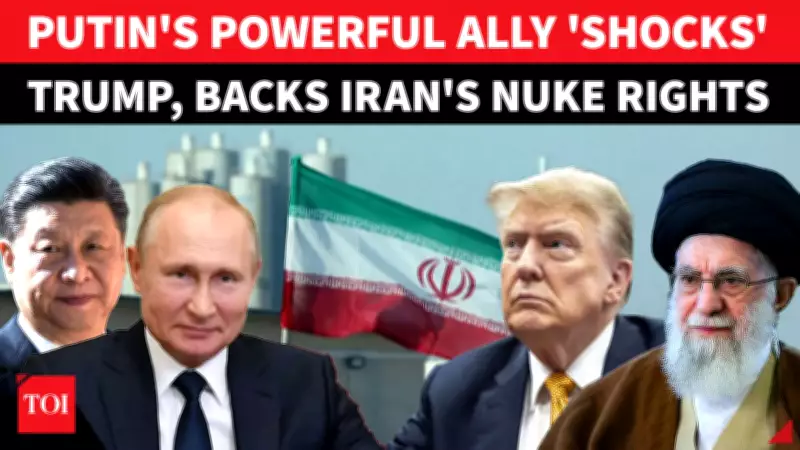
China Declares Support for Iran's Nuclear Rights Amid Rising US-Iran Tensions
In a significant diplomatic development, China has publicly thrown its weight behind Iran's right to pursue peaceful nuclear energy. This declaration comes at a critical juncture as pressure intensifies ahead of scheduled talks between the United States and Iran in Oman. Beijing has issued a clear warning against the use of sanctions, military force, and any actions that could escalate tensions in the already volatile region.
Beijing Advocates for Diplomatic Resolution
The Chinese government has emphasized its commitment to pushing for a diplomatic resolution to the ongoing standoff. Beijing's stance underscores its role as a key player in Middle Eastern geopolitics, positioning itself as a mediator advocating for dialogue over confrontation. This approach aligns with China's broader foreign policy objectives of promoting stability through multilateral engagement.
Meanwhile, Russia has described the situation between Washington and Tehran as "explosive," adding another layer of complexity to the international dynamics at play. The characterization by Moscow highlights the perceived fragility of the current geopolitical landscape, where miscalculations could have far-reaching consequences.

Behind-the-Scenes Developments and Denials
Reports emerging from diplomatic circles suggest that Iran has tentatively agreed to discuss contentious issues such as its missile program and support for militant groups during the upcoming talks. However, these claims have been swiftly and categorically denied by Iranian officials, creating a cloud of uncertainty around the actual agenda and potential outcomes of the negotiations.
In a related development, rare footage from inside an underground missile base operated by Iran's Islamic Revolutionary Guard Corps (IRGC) briefly surfaced on Iranian state media before being abruptly removed. This incident has raised numerous questions regarding Iran's strategic intentions, its deterrence capabilities, and the timing of such a disclosure amidst delicate diplomatic maneuvers.
Collision of Diplomacy and Military Signaling
The region now finds itself at a precarious crossroads where diplomatic efforts and military posturing are increasingly colliding. The convergence of these elements is pushing the Middle East toward a potentially decisive moment that could reshape regional alliances and security architectures. China's vocal support for Iran, coupled with Russia's stark warnings, indicates a growing multipolar involvement in what was traditionally a US-Iran bilateral issue.
As preparations for the Oman talks continue, the international community watches closely to see whether dialogue can prevail over escalation. The involvement of major powers like China and Russia adds both complexity and opportunity to the diplomatic equation, potentially influencing the trajectory of one of the world's most sensitive geopolitical flashpoints.