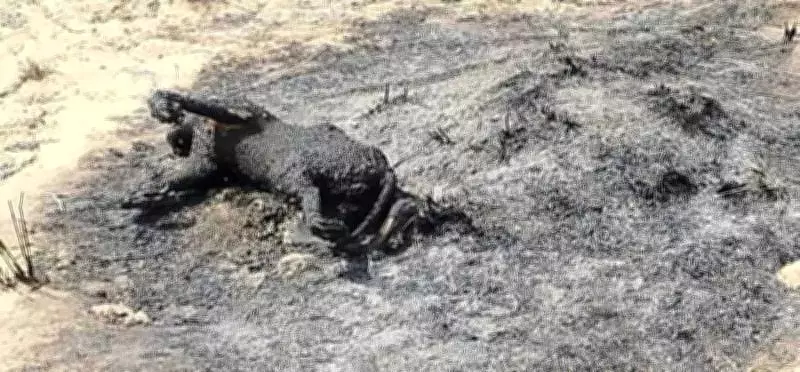
Charred Caracal Carcass Discovery in Rajasthan Reignites Extinction Concerns
The recovery of a charred caracal carcass in Rajasthan's Jaisalmer region has ignited renewed alarm over the fate of one of India's rarest wild feline species. Experts are issuing stark warnings that the elusive caracal is perilously close to vanishing from the country entirely.
First Recorded Killing in Four Decades
The body of the protected wild cat was discovered on Monday near the Shahgarh border area, allegedly killed by local residents in retaliation for livestock attacks. This tragic incident marks the first recorded killing of a caracal in Rajasthan in almost 40 years, a grim milestone for conservationists.
Forest officials reported that the carcass appeared to have been deliberately burned in an attempt to destroy evidence, as earlier social media footage showed no fire damage. Following a joint operation by forest department personnel and Shahgarh police, three suspects—identified as Ibrahim Khan (32), Uma (31), and Salidad (50), all residents of Shahgarh—were arrested. A tractor allegedly used in the crime has also been seized.

A Species on the Brink
The caracal, protected under Schedule I of the Wildlife Protection Act, 1972, faces a dire situation. Dharmendra Khandal, a field biologist and author of "Caracal: An Intimate History of a Mysterious Cat," emphasized the urgency of the crisis. "The presence of caracals in Rajasthan had been suspected, with past records hinting at existence across the border in Pakistan," Khandal stated, adding that urgent conservation measures are critically needed.
These measures include swift compensation for livestock losses to mitigate human-wildlife conflict and enhanced awareness campaigns within local communities. A senior forest official corroborated the bleak outlook, confirming that while exact population numbers remain elusive, the future is grim.
Severe Habitat Loss and Historical Decline
The caracal's plight is exacerbated by catastrophic habitat destruction. Experts report that nearly 95% of its historical habitat has already been destroyed, with its current extent of occurrence estimated at a mere 0.57% of its former range. As South Asia's most endangered wild feline, its population in India is now estimated to be fewer than 100 individuals, primarily concentrated in Rajasthan and Gujarat.
Historical data reveals 27 documented cases of caracals being hunted or killed by people before the Wildlife Protection Act was enacted in 1972. Reports later emerged of caracals being killed for their skins in Rajasthan in the early 1980s, with the last recorded poaching case in India dating back to 1985.
Ongoing Threats Despite Legal Protection
Threats to the caracal have persisted despite its protected status. Poaching remains a risk in parts of its range, while conflict with pastoralists has become an increasingly significant concern. In Gujarat's Kutch region, for instance, five of 19 caracal records between 2000 and 2020 involved animals killed after attacks on livestock. Similar incidents have also been reported from the greater Ranthambhore landscape.
Following the recovery, the forest department took the caracal remains into custody and registered an FIR. A post-mortem examination was conducted by a medical board, after which the carcass was disposed of according to protocol. Anoop K R, Jodhpur chief conservator of forests, noted that the recovery and arrests followed an operation in the Shahgarh area, approximately 3km from the Indo-Pakistan border, where the animal is believed to have been killed.
Call for Targeted Conservation Action
Conservationists are now raising the alarm that without a targeted and immediate conservation plan, the caracal could disappear from India altogether. The species' elusive nature and severely diminished population underscore the critical need for enhanced monitoring, community engagement, and habitat protection to prevent this iconic wild cat from slipping into extinction.