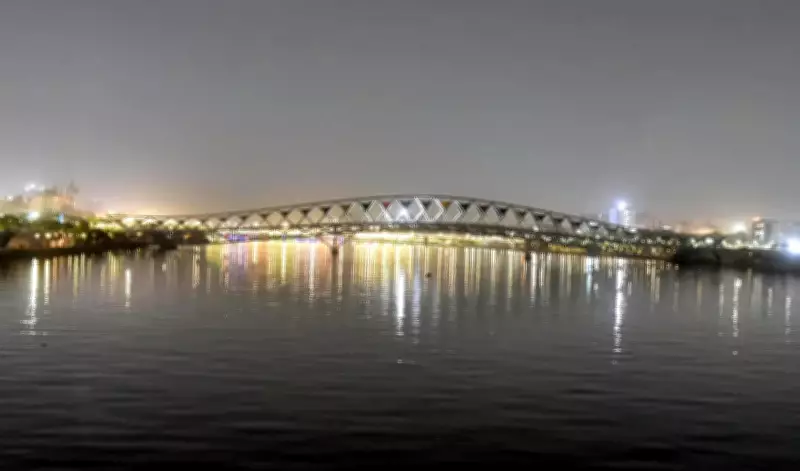
Ahmedabad: The city's artificial light at night has more than doubled between 2014 and 2022, according to a new study. Researchers warn that without intervention, night-time brightness could surge by an alarming 46.2 percent by 2027.
Satellite Data Reveals Sharp Increase
Satellite data shows that Ahmedabad's night-time radiance rose from 29.7 to 63.3 nanowatts per square centimetre per steradian (nW/cm2/sr) between 2014 and 2022. This unit measures the amount of light emanating from the Earth's surface to satellites. The annual growth rate was nearly 9 percent. Researchers predict that if the trend continues, radiance could reach 93.39 nW/cm2/sr by December 2027. The city began 2023 at 63.88 nW/cm2/sr.
Key Drivers of Light Pollution
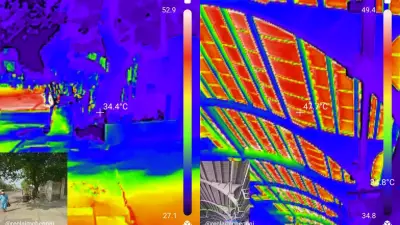
The study attributes the rise primarily to rapid city expansion, inefficient streetlights, and the proliferation of advertising billboards. On satellite maps, areas that once appeared light blue, indicating lower brightness, are now turning red, signifying stronger light emission.

The research, titled 'An Alarming Threat of Light Pollution in Ahmedabad City: Efficient Time-Series Forecasting Framework', was authored by Saikat Mondal and Parag Kumar Guha Thakurta from the Department of Computer Science and Engineering at NIT Durgapur, and PL Sikdar from the Department of CSE (IoT) at Techno Main Salt Lake, Kolkata. The study was published by Springer Nature Switzerland AG in a special journal.
Uneven Brightening Across the City
Researchers emphasize that the increase is not uniform across Ahmedabad. They examined night-time radiance around Bhadra and Lal Darwaza within a 500-meter radius. At this location, radiance grew from 38.473 nW/cm2/sr in 2014 to 53.888 in 2022, and is projected to reach 62.86 by December 2027. The study states, "The city is not brightening uniformly. It is intensifying most aggressively at its centre."
Health and Environmental Consequences
The study warns that excessive artificial light at night can disrupt the body's sleep-wake cycle. "Long-term artificial light exposure at night can alter circadian rhythms, which may result in sleep issues, mental health problems, behavioral changes, and metabolic disorders," it notes. Without action, the negative impacts on human health will worsen.
Light pollution also impairs the view of the night sky. The study observes that "the city at night may now witness fewer celestial objects with astronomy instruments due to night sky brightness that impairs human vision and observation of the universe."
Wildlife is also affected. The study lists birds, amphibians, reptiles, and coral reefs as being harmed by "excessive grouping of bright, confusing, or uncoordinated light sources."
Data and Methodology
The researchers utilized satellite data from the National Oceanic and Atmospheric Administration's (NOAA, US) Visible Infrared Imaging Radiometer Suite (VIIRS) to analyze and predict changes in Ahmedabad's light pollution from 2014 to 2022.
Urgent Need for Regulation
The study calls for urgent control of street lighting and outdoor advertising to mitigate the growing problem. Without such measures, the city faces a future of intensified light pollution with serious implications for health, environment, and astronomy.