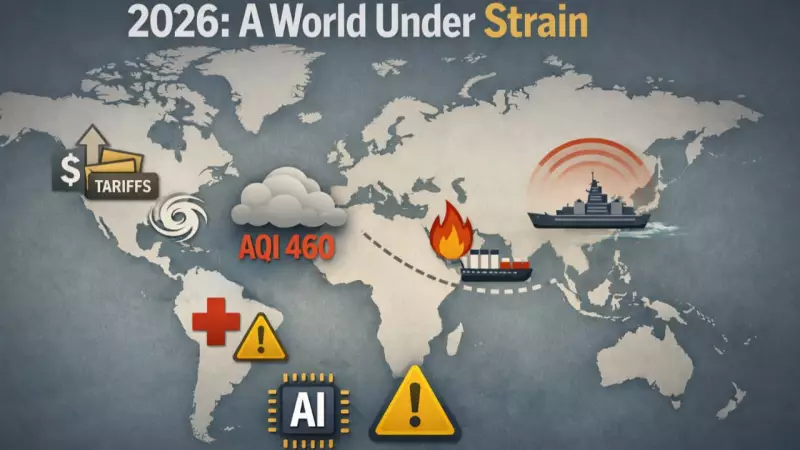
The dawn of 2026 finds the global community not stepping confidently into a new year, but navigating a precarious landscape defined by problems long postponed or ignored. The strain is palpable in the toxic air of megacities, volatile political shifts, and conflicts that stubbornly persist. What were once isolated emergencies now interlock, creating a state of permanent crisis where buffers are thin and the margin for error is vanishingly small.
Delhi's Chronic Haze Nightmare and Public Health Emergency
Delhi's air quality crisis has become a grim seasonal ritual. In the closing months of 2025, the national capital's Air Quality Index (AQI) repeatedly breached the "severe" category, with readings soaring above 450 on multiple days. To put this in perspective, an AQI below 50 is considered "good." A thick, toxic haze, laden with vehicle exhaust, industrial emissions, and smoke from crop burning, blankets the city of over 3 crore people, posing severe risks of respiratory illness.
Authorities have been forced to implement emergency measures like banning construction activities, restricting older diesel trucks, and even closing schools on the worst days. However, these are temporary fixes. Without decisive, long-term action—including tighter controls on all pollution sources and a rapid shift to clean energy and transport—Delhi's winter smog will continue to cripple public health and productivity throughout 2026 and beyond.

The Politics of Disruption: Trump's Tariffs and Transactional World Order
On the global stage, a second term for Donald Trump promises a doctrine of permanent disruption. Central to this is a radical trade policy. Announced on April 2—dubbed 'Liberation Day'—his renewed embrace of sweeping tariffs, including blanket duties and "secondary tariffs," has turned trade into a blunt instrument of economic force.
Export-driven economies across Asia, Europe, and Latin America now operate under the constant threat of sudden penalties, discovering that even alliance with Washington offers little protection. This volatility is straining supply chains painstakingly rebuilt after the pandemic. Trump's foreign policy follows the same transactional playbook, from aggressive oil sanctions on Venezuela that rock global energy markets to treating climate commitments and security guarantees as mere bargaining chips. The result is a weakened rules-based order, where raw power and leverage trump established norms, forcing every nation to plan for Washington's abrupt and unpredictable moves.
Extreme Weather: From Exception to Expectation
Climate change has decisively shifted the goalposts. Extreme weather is no longer a shock; it is the new normal. The year 2025 offered a devastating preview, with the United States alone experiencing a barrage of unprecedented disasters. These included Category 5 Hurricane Melissa striking Jamaica and catastrophic flash floods in Texas.
Climate scientists confirm the link: they reported that 89% of the record-high US temperatures in 2025 were made more probable by greenhouse gas pollution, which also intensified hurricanes and wildfire risk. The first half of 2025 was the costliest ever for US climate disasters. Globally, the year was on track to be among the top five warmest. The choice for 2026 and beyond is stark: continue fueling fossil fuel dependence and suffer escalating disasters, or accelerate the transition to renewables—which already meet 70% of new global power demand—to limit the damage.
China: The Engine of Strategic and Economic Uncertainty
In 2026, China will exert influence not through a single dramatic act, but as a constant source of background pressure. The sharpest fault line remains Taiwan. Beijing's military activities around the island—frequent air incursions and naval patrols—have become normalized, blurring the line between exercises and preparation for conflict. This strategy of sustained coercion keeps the region on edge and compels others to plan for worst-case scenarios.

Economically, China presents a paradox: it is too large to ignore yet facing internal fragility from a property slump, high debt, and slowing growth. Any major policy shift from Beijing on stimulus or currency will send ripples across global markets. Technologically, as Western controls on advanced chips tighten, China's push for self-reliance is accelerating a bifurcation of global systems, forcing countries into difficult choices.
A Crowded Security Landscape and the Next Health Threat
The global security picture remains bleak as 2026 opens. The Russia-Ukraine war grinds on in its fourth year, a brutal war of attrition. The Middle East remains a tinderbox, with the Israel-Palestinian Territories conflict prone to sudden escalation, disrupting Red Sea shipping and regional diplomacy. Beyond these headlines, wars in Sudan, the Sahel, and eastern Congo fester, often ignored until humanitarian crises explode.
Meanwhile, the next health crisis is quietly brewing. The World Health Organization warns that antimicrobial resistance (AMR) now affects one in six bacterial infections, threatening to make common illnesses deadly again. Despite this, global health funding is stressed. 2025 saw massive outbreaks, including over 300,000 cholera cases in Africa and record dengue fever in Latin America, fueled by climate change. Even wealthy nations like the US and Canada saw resurgences of measles due to vaccine hesitancy.
Technological Disruption and the AI Dilemma
Rapid technological advancement, particularly in Artificial Intelligence, presents a profound double-edged sword. A 2025 Pew Research study found 57% of Americans believe AI poses high societal risks, chiefly through supercharged misinformation and convincing "deepfakes" that could destabilize elections. Beyond disinformation, AI challenges privacy, cybersecurity, and employment. Governance is lagging, with laws like the EU's AI Act playing catch-up.
The AI investment boom also raises alarms. A "circular" model has emerged, where tech giants like Microsoft and Nvidia invest in AI startups that then spend that money back on their cloud and chip services. This creates a self-feeding financial loop that fuels explosive growth but may mask underlying costs and bubble risks.
As 2026 unfolds, the greatest danger may be complacency. A world growing accustomed to disruption risks mistaking perpetual instability for a sustainable state. The turning points of history are rarely announced with fanfare; they arrive as the accumulated weight of visible, unaddressed problems. In this sense, 2026 represents less a beginning and more a stark reckoning with what the world has tolerated for too long and what it can no longer afford to ignore.